Can Performance Evaluation Systems Create and Sustain Success?
Performance management systems aren’t reaching their full potential, and organizational psychologist Ben Dattner says it’s time for a change

Author of Credit and Blame at Work: How Better Assessment Can Improve Individual, Team and Organizational Success (Free Press), New York City-based Organizational Psychologist and Executive Coach Dr. Ben Dattner was once approached by a large law firm who asked him to resolve a hiring dispute among the partners at the firm:
“Is it better to hire someone who was last in their class at the country’s most selective law school, or first in their class at a less selective law school? Our partners strongly disagree about this question. Some feel that simply having gained admission to the most prestigious law school reflects natural talent and a rare degree of intelligence. Others feel that they would rather have a ‘hungry’ highly motivated associate with something to prove rather than an unmotivated ‘prima donna’ elitist who is only briefly sojourning at the firm on the way to a Supreme Court clerkship or professorship at a law school. We would like data to answer the question.”
As a next step, the firm sent Ben a large data set with more than one hundred predictor variables about each of their associates and partners, including academic and professional credentials, and, of course, where they had each attended law school.
Although there was a very rich set of “independent” or “predictor” variables, Ben soon discovered that the firm did not have any clearly defined “dependent” or “outcome” variables as there was no robust performance management process and there was no consistent metric of attorney success other than how much they billed, which all the partners (in a rare demonstration of consensus) agreed was too variable by office, department and business cycle to be meaningful as a success factor.
Therefore, despite all the data, there was actually no data-based way to resolve the disagreement between the two opposing camps of partners, and the firm lived unhappily ever after- utilizing subjective judgments and individual preferences to assess candidates rather than rigorous statistical analysis.
Ben brought up this example in our most recent Zal.ai Thought Leadership Interview to describe how organizations underutilize the performance review process. The majority of organizations use it to evaluate individual performance and justify changes in compensation, but its true utility should go much further in the full human capital cycle of assessment, hiring, onboarding, coaching, evaluation, promotion and compensation . In a changing technological landscape optimizing investments in human capital has become more important than ever.
The Performance Appraisal is Political
Ben has learned over the years that the first and most crucial mistake that most organizations make when it comes to performance management is assuming that because employees are evaluated based on quantitative metrics that the system is somehow “objective.” The truth is that the performance appraisal is always informed by organizational politics, preferences and priorities.
There are two ways in which standard performance appraisals can reflect organizational dysfunction:
Organizational politics determine what the system evaluates
Imagine a hypothetical performance evaluation system at General Motors in the 1950s with items such as “This person successfully designs, manufacturers or sells large, gas-guzzling cars.” At the time, this might have been perfectly appropriate. However, in the later 1970s there would need to be a change, as the old criteria needed to be replaced with something along the lines of “This person successfully designs, manufacturers or sells fuel efficient cars that can compete with Japanese imports.” If the organizational politics within GM caused resistance to change, those new criteria would likely have appeared on employee reviews years or even decades later than they should have.
Organizational politics determine how employees are evaluated within that system
Performance appraisal systems are too often impacted by favoritism or bias and reward employees who don’t challenge the status quo and/or those who kiss up to their bosses. Also, as has been much discussed and debated in recent years, demographic factors can impact which individuals or groups benefit from an “unlevel playing field” in different organizations in different contexts and it seems that grievances are only growing all around.
“What gets measured is what gets done” means that when the what and the how of performance evaluation are political, performance itself becomes political. Managers and employees alike become more focused on style than substance and perceptions rather than reality. By focusing on internal noise managers and employees are much less likely to sufficiently attend to the signals they should be getting from external changes in their competitive environment.
A More Holistic, Outcome-Based Alternative
To Ben, improving this inherently ineffective system means changing it on a fundamental level. Instead of building the performance appraisal on the basis of uni-directional judgement, what if it was a form of bi-directional communication and collaborations between employees and managers?
Traditional performance systems are based on evaluating an individual’s value to the company, but Ben advocates for a system whose main purpose is to monitor and drive performance for team, departmental and entire organizational performance. In Ben’s ideal system, the performance review acts as a dynamic bridge between worker and context, providing the company with a view of both how employee performance can be improved within the system and how the system can be improved to optimize employee performance.
Standard performance appraisals might assess how well an individual employee is performing or if they merit a raise, but Ben’s suggested system also analyzes whether the manager and the organization is creating the foundation for collective performance and/or what needs to change in order to create the conditions for greater future success.
A performance management methodology that provides a bridge can be doubly beneficial: it supports employee development while simultaneously giving leadership relevant and reliable performance data to make better strategic decisions. By moving from an individual to a systemic mindset, managers and leadership can diagnose the problems at hand rather than blaming employees for not performing within a suboptimal organizational context that itself needs to improve.
To demonstrate, Ben asks us to imagine a company where the majority of salespeople aren’t meeting their sales targets. A standard system might criticize the individuals in the form of low performance ratings. However, he advocates for a system that suggests, “If none of our salespeople are meeting their targets, maybe we need to improve our products.”
These system-level insights can lead to company-wide progress. Now, instead of those salespeople feeling alienated by low ratings, they might feel heard when the company reassesses and improves its product offerings. In this way, the performance management system can become “the tail that wags the dog” of the company’s overall configuration and competence.
Building Trust Through Mutually Beneficial Performance Systems
Ben explains:
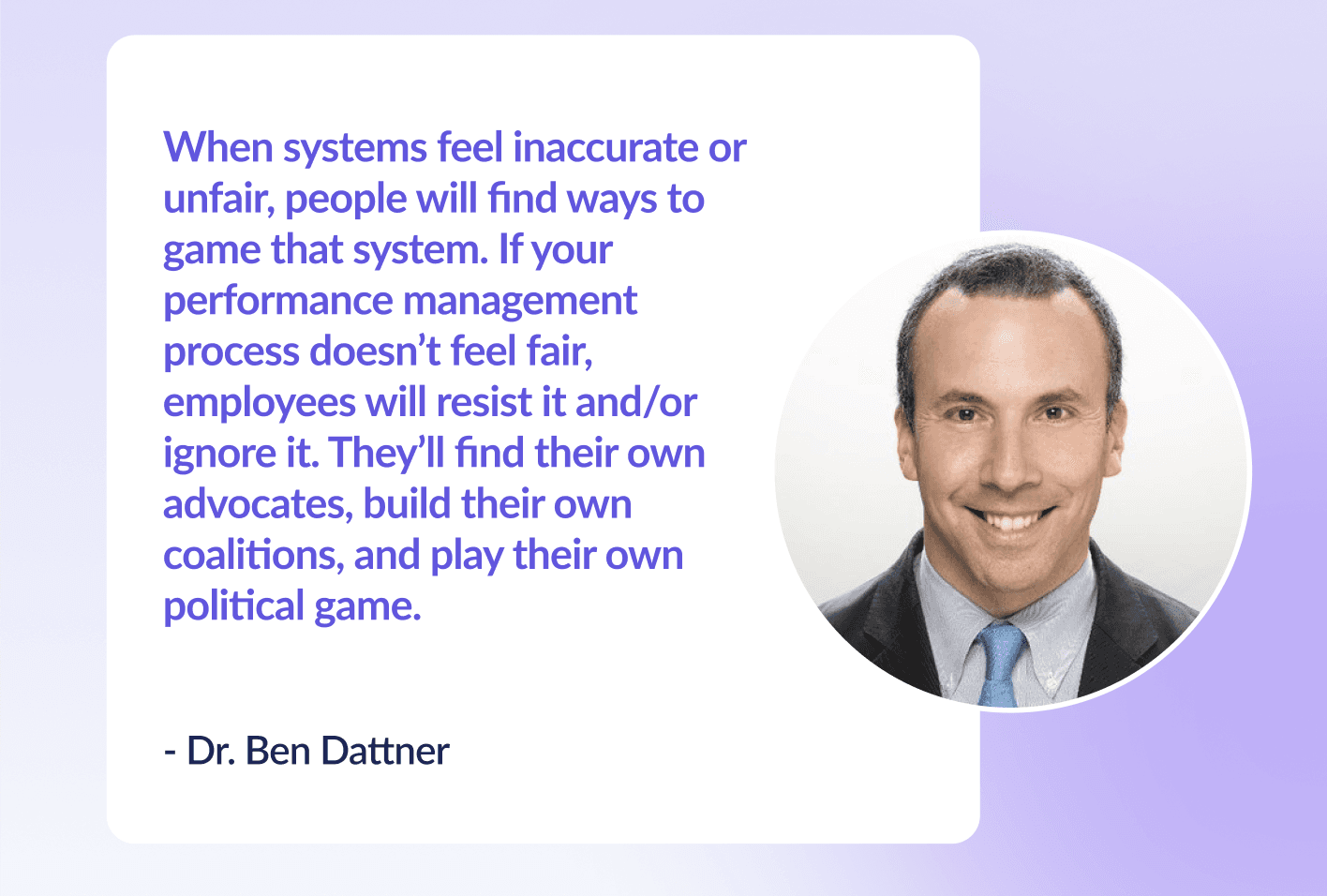
“When systems feel inaccurate or unfair, people will find ways to game that system. If your performance management process doesn’t feel fair, employees will resist it and/or ignore it. They’ll find their own advocates, build their own coalitions, and play their own political game.”
However, by implementing a transparent and accountable system that serves both employees and executives, companies can proactively prevent the performance appraisal from becoming a tool of workplace politics.
This is the ultimate criterion for the success of any performance system: does it actually enhance organizational performance?
A Path Forward
“The best systems force organizations to question assumptions and to assess what factors are enhancing or constraining individual, team, departmental and organizational success,” Ben explains. “Theory drives data and data drives theory. Questions are openly generated and mindfully answered and progress gets made over time.”
Performance management systems should encourage leaders to truly contend with the causes, effects and implications of employee performance and experience. HR leaders should get and have the tools to understand their employee’s perspectives and suggestions, and respond promptly and constructively. Performance management should be an evolving set of tools that drives team-based performance, and creates and sustains the foundation for individual and collective success. Good performance management systems don’t just measure and evaluate individual success, they are an integral component of creating and sustaining organizational success.
Learn more by following Dr. Ben Dattner on Linkedin and visiting Dattner Consulting.