The First Team, Team First Mentality: Transforming HR from Middleman to Business Driver
Em Kintner explains that HR success lies at the intersection of supporting leadership and understanding the workforce.

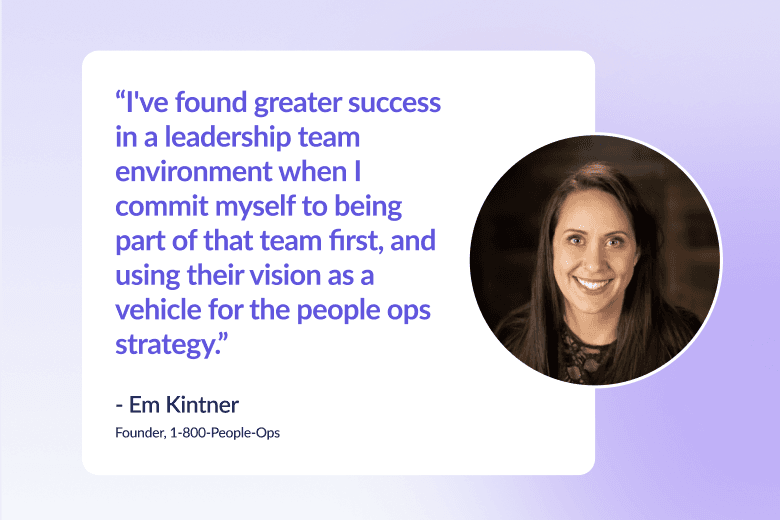
Em Kintner is the founder of 1-800-People Ops, a fractional people operations practice that helps early-stage tech companies prioritize their people, and in doing so, prioritize success. As a human resources expert, she is known to create performance cultures that not only manage the workforce, but drive success in business objectives for the company as a whole.
How does she do this? By redefining the way HR leaders approach their role in the company hierarchy. She says that we need to “switch the narrative that HR and the rest of the leadership team are at odds.”
Kintner says that HR leaders are naturally people-focused, and when caring about the workforce deeply doesn’t seem to mesh with company objectives, a rift often forms between them and company leadership. When this rift forms, HR can feel frustrated that their opinions and recommendations aren’t being heard or acted upon. This creates what Kintner calls an underlying “adversarial narrative” between HR leaders and executives, one that limits teamwork and mutual success.
In her work, Kintner avoids this “adversarial narrative” with a foundational mindset shift, one that benefits all parties involved:
“Success really happens when you see your CEO or your exec team as collaborators and really focus on understanding what's keeping them up at night. Give them the benefit of the doubt that they're seeing it all and may choose or default in this early stage to do things that may impact your employees' experiences.
Now that's not to say that you should sit on your hands and abandon your agenda. But I've found greater success in a leadership team environment when I commit myself to being part of that team first, and using their vision as a vehicle for the people ops strategy.”
By understanding that HR leaders are, in fact, members of the executive team themselves, they can take the time to understand the leadership’s motives, and best position themselves to promote people and performance success within the actual context of the business.
However, Kintner makes it clear that in embracing their role as part of the executive team, HR leaders can not forget that their ultimate goal is to support and improve the employee experience.
She says:
“Check-in with your employees, listen to your people, because otherwise the other stuff doesn’t matter.”
By encouraging both these paradigms at once, Kintner reframes the thought process of the effective HR leader into one we’ll call ‘The First Team, Team First Mentality’.
The First Team: How Understanding Leadership can Drive Culture
"At the end of the day in the early stages, your leadership team and your CEO are going to be the single driver of your culture. Your CEO, the way they operate, the way they talk, the way they make decisions - that is the thing that drives your culture." says Kintner.
As the defining force behind company culture, the leadership team's motives and expectations are key to grasping the organization as a whole. By understanding themselves as an integral part of the executive team, HR leaders not only gain an insider perspective on the motivations behind the culture, but they can make effective people operations a foundational element of the organization.
Because of this, to Kintner, the First Team Mentality is all about fostering open and frequent dialogue between HR and every member of the leadership team. By being aware of the most pressing obstacles or growth avenues for a company on an executive level, HR can act as a “glue person”, and performance management can become a tool utilized for business success:
“If you're checking in with the Head of Engineering , CEO, or other executives on a weekly basis, you’ll be able to understand what is most concerning for them in the business, and help connect the dots with other levels of the company.”
If HR leaders see themselves as part of the executive team, they can bring their knowledge of performance at the managerial and employee levels to leadership to create more holistic and effective solutions.
The Team First Mentality allows people operations and performance management to become truly integrated parts of company culture, and reframe it to support business growth as a whole.
Team First: How Direct and Adaptive Performance Management can Serve the Workplace
The Team First Mentality is built on listening to employees and managers, and developing a performance management system that suits their unique needs. There are standardized performance mechanisms used across organizations, but Kintner argues the mark of a great HR leader is when they are not afraid to mold their performance management to a company’s needs.
She gives an example of a client who spent years building a continuous feedback model within their organization that involved weekly check-ins and small inputs delivered regularly and unceremoniously. The team was able to utilize this feedback model to its fullest because they were mostly senior and experienced in their field.
However, as the company grew, an EOS coach recommended formalizing feedback through quarterly performance reviews. The team pushed back strongly on this idea because it would have brought work anxiety and miscommunication into a process that was already working well for them.
"It's just these little bite-size pieces of feedback that feel a lot less scary. In this system, [Managers] are slowly working with someone to be their best self, versus this big scary quarterly gob of information that nobody wants to hear."
In this situation, the client had already built an agile model that took the specifics of the team into account and created a process that helped them perform well. A quarterly system would have ruined this dynamic by implementing a process that would not have increased performance, and eventually business, success.
This is an example of why, when Kintner is brought into a new company to fix their people operations, she never starts by implementing a formal performance review cycle. It is much more important to her to take the temperature of the team, and understand what tools would work best for their work culture.
One process that Kintner uses regularly to understand real-time team dynamics is a manager meeting:
“One of the things that I like to utilize is a monthly manager meeting where all the managers get on and you go through everybody's team and direct reports. This might surface issues, or show that somebody is killing it. Either way, everyone walks away with some very small bite size action items for each one of their employees on a rolling, continuous basis. This is a lightweight way that we can start giving people some baseline feedback.”
This process has multiple benefits for the HR leader: it encourages a feedback culture where performance conversations are the norm, it creates a designated space where managers can reflect on team performance, and it allows the HR leader to listen to their managers to get real actionable input on the state of the company.
This is the essence of the Team First Mentality. Instead of rushing into a formalized system, Kintner first takes the time to understand the team, and assesses which tools can fit the current situation the best. She also gains the knowledge to return to the leadership team with a real actionable understanding of the company on multiple levels.
The New Age of Effective, Agile, and Adaptive HR Leaders
As AI fundamentally changes the workplace, HR leaders must adapt quickly if they want to preserve company values and promote business success. To Kintner, adapting doesn’t look like just becoming technological savvy, it looks like becoming a more deliberate, intentional, and perceptive leader.
The First Team, Team First Mentality is about understanding an organization on all levels. By assuming the role of executive, you gain high-level knowledge about company direction and mission. By creating bespoke performance management processes for managers and employees, you stay in touch with the day-to-day ground level specifics of the team. Together, this allows for the kind of holistic view that can actually make HR leaders the real connective tissue of the company.
To learn more, please follow Em Kintner on Linkedin and visit 1-800-People-Ops.