The New Accountability: Powering Human-Centered People Operations
Strategic Leadership Consultant Sarah King explains her three-pronged process to create a truly welcoming workplace.

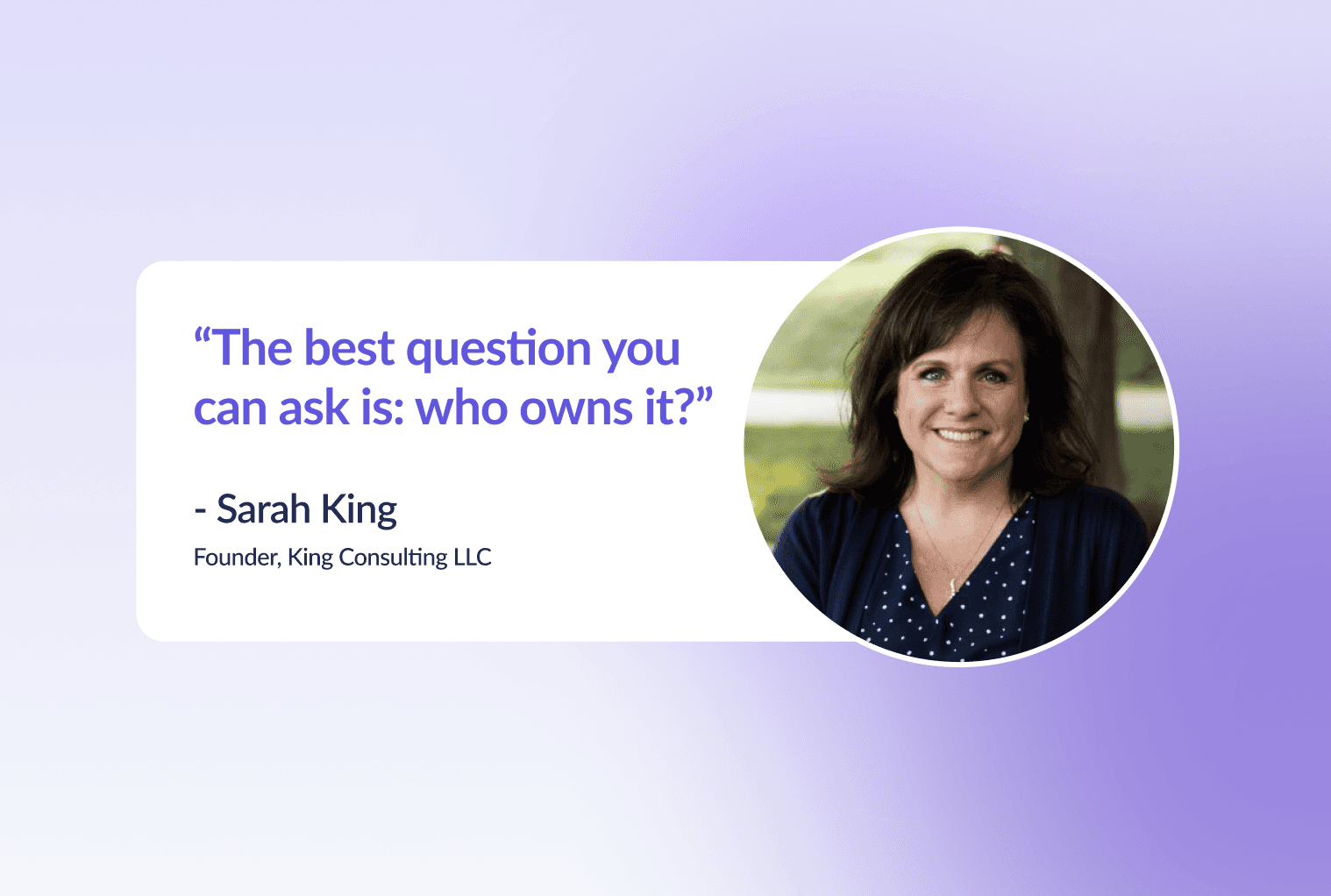
Often, when HR leaders argue for a human-centered philosophy to people operations, the focus is on getting to know the unique needs of your workforce and understanding how performance management can support them. But to Sarah King, Founder of King Consulting LLC, a crucial element of the human-centered view is often missing from the conversation: accountability.
King has had two decades worth of experience as an HR leader, including helping companies in blue-collar operational sectors improve worker experience and performance. When asked, King is candid about the problems with the industry from a people ops perspective: the buddy-buddy, male-dominated work culture can blur personal and professional lines, and by doing so, can potentially derail a business.
“If you get too close, too familiar, too into a relationship in the workplace, you don’t recognize how much it impacts your business negatively and you don't know how to pull back.”
King argues that it’s common for executives to hire people who have an existing relationship with them, like a college roommate, or a spouse’s friend. These practices often bring personal power dynamics into the workplace, and more likely than not, get in the way of professionalism, accountability, goal achievement, and business success.
These relationships can cause artificial hierarchies in the business, and lead to preferential treatment when it comes to compensation and promotions. To King, this is part of the issues that can keep some male-dominated industries, including boatyards, building materials, manufacturing, and construction, from becoming diverse on a leadership level.
To clarify, strong personal relationships aren’t inherently a bad thing in the workplace, they can actually lead to high levels of goal alignment and mutual achievement, but only when these relationships are part of a system that keeps them productive and protects them from becoming disruptive.
So we asked King what she does, as a fractional people leader, when she is brought on by a business that has little separation between the personal and professional. What can be done to give leaders a tactile way to hold people accountable without weaponizing their personal relationship?
Her answer was a masterful roadmap to creating effective boundaries in the workplace, one that recognizes long-standing personal relationships but chooses to prioritize supporting the entire workforce equitably. She outlines three steps, each profoundly impactful in their own ways, that can lead any HR leader to establishing a new kind of professionalism, one that puts people first.
Step 1: Establish Ownership
“The best question you can ask is: who owns it?”, says King.
This is one of the first questions King asks when advising a new organization. By delineating tasks very deliberately to each individual, she sets clear expectations across roles. Because each employee knows their responsibilities, there is little room for blame-shifting based on personal biases.
But the ownership paradigm is twofold: not only should each employee understand their responsibilities, managers and leadership should take ownership when delivering constructive feedback.
King gives an example of an employee approaching her to ask about purchasing an expensive piece of work equipment. The finance team has told King that they can’t afford new equipment, so she must deny the employee’s request.
Instead of blaming finance for making this decision, she takes ownership of the feedback, telling the employee that the entire leadership team has come together to make this decision because of insufficient funds. In this way, she reinforces the professional boundaries between leadership and employee rather than shifting blame.
When it comes to workplace hierarchies, King says that HR leaders should always ask, “Who’s going to give the feedback and what is that feedback going to look like?”. By frequently using the ownership muscle, alignment amongst leadership is prioritized over protecting personal relationships, removing bias from performance conversations.
By assessing task ownership, HR leaders also get the opportunity to understand where the strong personal dynamics exist, and avoid situations where deeply involved individuals are responsible for each other’s feedback. King looks to avoid situations where she puts someone in charge of feedback if she knows that “behind closed doors, the manager will just give his friend a slap on the back”.
This two-pronged approach allows HR leaders to both reset expectations, but also reorganize the company hierarchy so all are held accountable, and aligned toward business success.
Step 2: Recognizing that “What’s Allowed Will Continue”
When King joins a particularly personally intertwined organization, she makes it a point to address and remove any cultural norms that promote personal bias in performance management.
“If an employee doesn't know that they’re doing something wrong, they’re just going to keep doing it. If a manager is watching an employee do something they shouldn't and allowing it, it's going to continue,” says King
King urges HR leaders to stamp out regressive cultural norms that reinforce inequality. She remembers a particular moment where she noticed that a company had a culture of having informal meetings after a formal meeting. After a team meeting, people would go off with their closest friends at work to discuss their thoughts about the meeting. King noticed that this created predetermined rifts in the team. The team meetings became unproductive, and real discussion between the team was limited. King told the group:
“No meetings after the meeting. Whatever we talk about in this room, we need to address it as a group. Because your opinion is important to everyone making the right decisions.”
By encouraging workers to share their opinion in meetings, King makes it clear to the group that the informal meetings were negatively affecting the company. The way she disallows the process also elevates employee voices by encouraging them to share and telling them that their voice is influential in the team meeting space.
She communicated to the team that this practice was not allowed, and in doing so, levelled the playing field of the team meetings. In making this clear, King created a more equitable workplace.
Step 3: Use Feedback Conversations to Develop a Supportive Rapport
“You have to understand somebody’s motivation to be able to give them really good feedback.”
To King, one of the most effective ways to combat the personal-professional bleed as an HR leader is to go out of your way to develop supportive relationships with employees across the organization. This can help employees that do not have the same political standing as others still feel heard and understood by company leadership. If done correctly, it can even help them feel agency over their situations and reaffirm their belonging.
King gives a powerful example of a day when an employee arrived at work dressed inappropriately according to the company’s standards. People approached King throughout the day to let her know that the employee wasn’t following company guidelines, but instead of addressing it immediately, King waited to pull her aside until the end of the day, knowing that the employee’s commute prevented her from going home easily to change.
After informing the employee that she was dressed inappropriately, King made a point to understand her reasoning. She asked the employee how she had decided on the outfit that she was wearing, and this revealed that she had misunderstood one of the finer points in the company’s dress policy, and King had given her some new rules of thumb to use when choosing clothes for the workplace.
Instead of assigning blame to the employee, King approached the situation with genuine care. She allowed the employee to explain her reasoning and worked with her to reach a mutual solution instead of assigning blame. By giving this employee the courtesy to review her actions, what could have been a punitive moment became a collaborative one.
By taking the time to understand the employee’s motivations, King makes what could have been a very isolating moment into a straightforward, fixable situation. This sort of caring professionalism encourages belonging in the workplace by extending each individual the same courtesy.
Toward an Equitable Workplace
King’s professionalism isn’t the cold, unfeeling kind that we usually see play out in pop culture. It is a welcoming, substantiating mindset that is also very strategic. It leads a culture shift by resetting values and enforcing them with emotional grace. It is in service of a connective culture, one that chooses to bring all team members into the inner circle of the organization rather than penalize those who have created meaningful personal relationships.
This active mindset switch transforms the HR leader from a facilitator to a driver of culture, one that can bring teams together in the pursuit of company objectives.