Can AI Humanize Performance?
Author and Founder Stela Lupushor discusses how HR can redesign performance for the AI era.

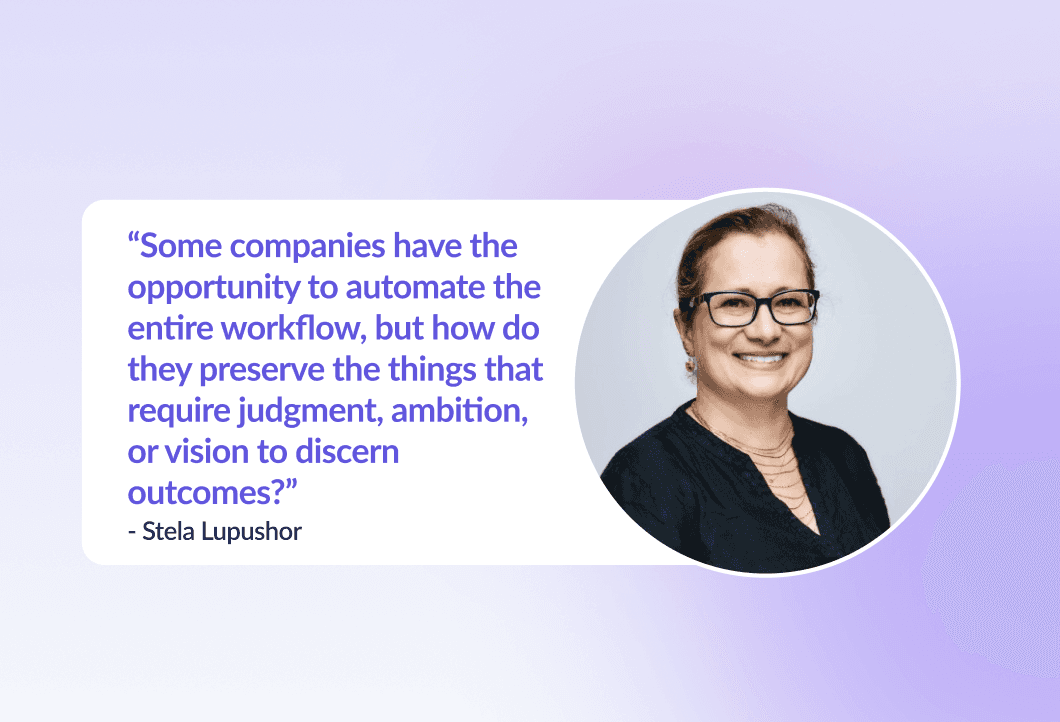
We are entering a new age of AI transformation in the business world. Over the past few years, many companies have successfully implemented and invested in AI technologies but, to Stela Lupushor, Chief-Reframer at Reframe.Work Inc, 2026 will be about the results.
She says,
“It's really the end of an era of experimentation with AI. Businesses have started looking at the outcomes. The question is: are you really accomplishing what you've intended or just wasting money on the back end? If a company says AI is improving performance, is there evidence to that? I think the tolerance level to experiment and pilot is decreasing.”
While implementation will continue as new use cases arise, executives have begun looking for assurances that their investments are having the intended impact. That shift creates real risk. Companies under pressure to show ROI are more likely to use AI for short-sighted cost-cutting that erodes long-term capability and talent pipeline building.
Lupushor, co-author of two books, Humans at Work and Humanizing Human Capital, argues HR leaders are central to making AI transformation work by looking beyond productivity and designing it to build expertise.
Purposeful Automation
“Often, we think of AI as just another automation opportunity. We look to abstract, obfuscate, and remove the repetitive time-consuming activities, but rarely do we see this as an opportunity for us to step back completely and question if this activity is necessary in the first place?” says Lupushor.
AI automation can cut costs and speed things up. But Lupushor points out that those gains come with a tradeoff: if automation obscures how work actually gets done, organizations lose the expertise they'll need to troubleshoot or reimagine things in the future.
Lupushor comments,
“Some companies have the opportunity to automate the entire workflow, but how do they preserve the things that require judgment, ambition, or vision to discern outcomes? Regardless of what we automate, we must make sure we are not automating our understanding of the workflow completely.”
Excessive automation can limit experience-based growth. This kind of growth that builds organizational knowledge you can’t replicate with a training module.. Lupushor uses her own work as an example:
“As a consultant I used to do deep research that might take me weeks, but now I can launch several AI research models in parallel and compare the outcomes. I save a lot of time on the grunt work, but I still need to refine, synthesize, and verify the data. These are critical thinking skills that I developed over the span of my career.”
Organizations will still need senior-level expertise. The question is whether AI automation is designed to develop/grow it or accidentally prevent it. As the department that oversees employee performance, HR has a central role to play in identifying how to automate in a way that facilitates that growth.
Lupushor mentions Moderna’s recent decision to merge HR and technology under a single leadership role as a signal that organizations are starting to recognize the connection between people strategy and technology implementation. Whether that specific model scales remains to be seen, but the instinct is right.
“Technology and HR must codesign the workplace - from how tasks are allocated to how growth is measured and how performance is quantified (and paid).”
As work itself changes, HR has two jobs: help the organization adapt to AI, and use AI to do HR better.
Addressing the Trust Crisis
When asked why 95% of managers are dissatisfied with the performance review process (Bonusly, 2023, CEB) and why only 14% of employees strongly agree that their performance reviews inspire them to improve (Gallup, 2023), Lupushor pointed to what she calls, “the trust crisis”.
“Workers do not trust how they are being evaluated. We use the performance management system to rationalize salary decisions instead of using it for what it is intended for: performance,” says Lupushor. She argues that the quarterly or annual performance review system doesn’t actually address performance, but acts as a proxy for compensation discussions.
Therefore, most employees and managers don’t have a platform to discuss feedback in a productive manner. This leaves all parties feeling disenfranchised. To fix this, HR needs to reframe performance management entirely - decouple it from compensation and rebuild it around continuous feedback...
Lupushor mentions that HR leaders have been advocating for this decoupling for decades, but there hasn’t been a notable shift because these ideas are not built into the standard HR operational system.
However, the AI transformation might give people leaders a chance to disrupt those standard systems.
AI x Performance
To Lupushor, AI disruption in the HR space is intrinsically tied to the definition of performance itself: “Performance is simply an individual’s reaction to the context in which they work. What constitutes this context? It is the team environment, the work politics, the tasks, the payout and reward system, and anything else that involves our experience in the workplace.”
Most performance evaluation systems fail to capture this context. They focus almost entirely on one element - the payout and reward systems. This issue lies at the root of the corporate performance management crisis.
If there were an operational system focused on capturing this context, both managers and employees could receive focused, tailored feedback to encourage growth and advancement. Lupushor says that by combining artificial intelligence technology with human-centered feedback practices, we can get there.
AI can track employee performance data and provide coaching advice to supplement the manager’s interpersonal knowledge, constantly aiding HR and the manager in capturing the entire context of the employee’s work experience.
When employees actually engage instead of going through the motions, team communication and performance improve.
Lupushor comments, “the manager and AI combo has the potential to open collaboration in a way that creates the perfect environment for people to do their best.”
A Critical Window
The window is open. Companies are willing to rethink how AI works in their organizations. HR leaders who use this moment to redesign performance (not just digitize it) will define what good work looks like for the next decade.
Learn more from Stela on Linkedin and at Reframe.Work