Reclaiming Confidence in the Age of AI
HR thought leader Stephanie Shuler on strengthening performance systems in an AI-Shaped workplace

To Stephanie Shuler, Chief People Officer at LifeLabs Learning, “this is the year where the rubber truly meets the road on all fronts,” on how we lead through AI-driven change
AI implementation is rapidly transforming the workplace. As AI reshapes how work gets done, organizations are in the thick of navigating role evolution, skill shifts, and rising anxiety about long-term security. For Shuler, the challenge isn’t simply technological adoption. It’s maintaining trust, clarity, and performance clarity and integrity while change accelerates. “The more automation increases, the more intentional HR leadership has to become,” Shuler explains. “AI doesn’t erode trust. Poor leadership during change does.”
In our most recent interview for the Zal.ai Thought Leadership Series, Shuler gave us a roadmap for how leaders can preserve employee growth and prioritize team development in our tumultuous technological landscape.
The Importance of Preserving True Performance Management
In moments of transformation, performance systems stop being retrospective evaluations. They become forward-looking talent allocation tools. They determine where skills are built, where roles evolve, and where resources move. So, if those systems distort under pressure, transformation slows.
Shuler says that when companies lead with AI-driven restructuring without clearly articulating their people strategy, it “reinforces the notion that they are choosing technology over people.” That perception increases job anxiety and erodes trust in the remaining workforce. When anxiety rises, performance systems begin to warp. Whether intentional or not, it signals that leadership may no longer value long-term employee growth. The result? Performance conversations shift from growth and impact to self-preservation and risk mitigation.
Shuler notices that self-inflation in performance evaluations becomes prevalent in these moments: “With self-inflation, employees are likely coming from a place of fear. This fear might not even be distrust of your direct manager, but distrust of the entire system, and fear of the consequences if you are not perfect.” She doesn’t see this as dishonesty so much as a predictable psychological response in high-stakes moments.
And it doesn’t stop with individual contributors.
Managers are under pressure, as well. They are being asked to accelerate adoption of new technologies, evolve roles, and build new capabilities, all while navigating uncertainty within their own teams. As Brandon Sammut, Chief People Officer at Zapier, has said, the people closest to the problem are best equipped to solve it. In workforce transformation, that’s your managers. Their people leadership is critical. Unfortunately, if communication around change is unclear, managers will absorb that pressure. The stakes rise. And when managers are under-supported in high-stakes moments, performance conversations weaken and inflation becomes predictable.
No performance management tool or system can compensate for a culture where feedback has become distorted. In workplaces shaped by anxiety and self-preservation, even well-designed systems become performative. The gap between employees and management widens, and no rating scale can fix it.
“Messaging around the purpose of AI automation is key,” Shuler says. Leaders must define the criteria by which roles will evolve, what skills will matter more, and how decisions will be made.
“This gets complex because jobs will be impacted,” she explains. “Leaders should be able to say, ‘This may change your role. It may even eliminate it. Here’s how we’re evaluating capability. Here’s what we’re investing in. Here’s how we’ll support transition.’ ” Shuler says it’s not enough to communicate what AI is going to do for the business. Leaders must also communicate what the business will do for its people.
When that level of transparency exists, performance systems retain their effectiveness. Managers can assess skills against forward-looking standards. Employees can focus on capability gaps instead of protecting their narrative. Reskilling becomes concrete rather than symbolic.
Before turning to layoffs, Shuler encourages leaders to examine redeployment, reskilling, and role redesign aligned to long-term strategy. Performance data should visibly inform where the organization is building capability, not simply justify where it is cutting cost. Shuler comments that these efforts “signal to both the employees who exit and the employees who are still remaining that you care about the people and you’re not valuing the technology above all else.” How you announce and handle exits speaks louder than how you announce innovation. The remaining workforce is watching closely. Those moments determine whether transformation feels strategic or transactional. Your people who remain have to execute the strategy. If they leave the process feeling respected and clear, they engage. If they leave feeling expendable, performance becomes defensive.
Prioritizing Performance Systems is Prioritizing Business Success
In the age of AI, high performance and innovation are not driven by automation programs alone. They are driven by how performance is defined, rewarded, and discussed. If performance systems are governed by fear of replacement, behavior follows.
Psychological safety is not the absence of accountability. It is the presence of clarity. High performance requires both.
For Shuler, the shift begins with recalibrating the standard.
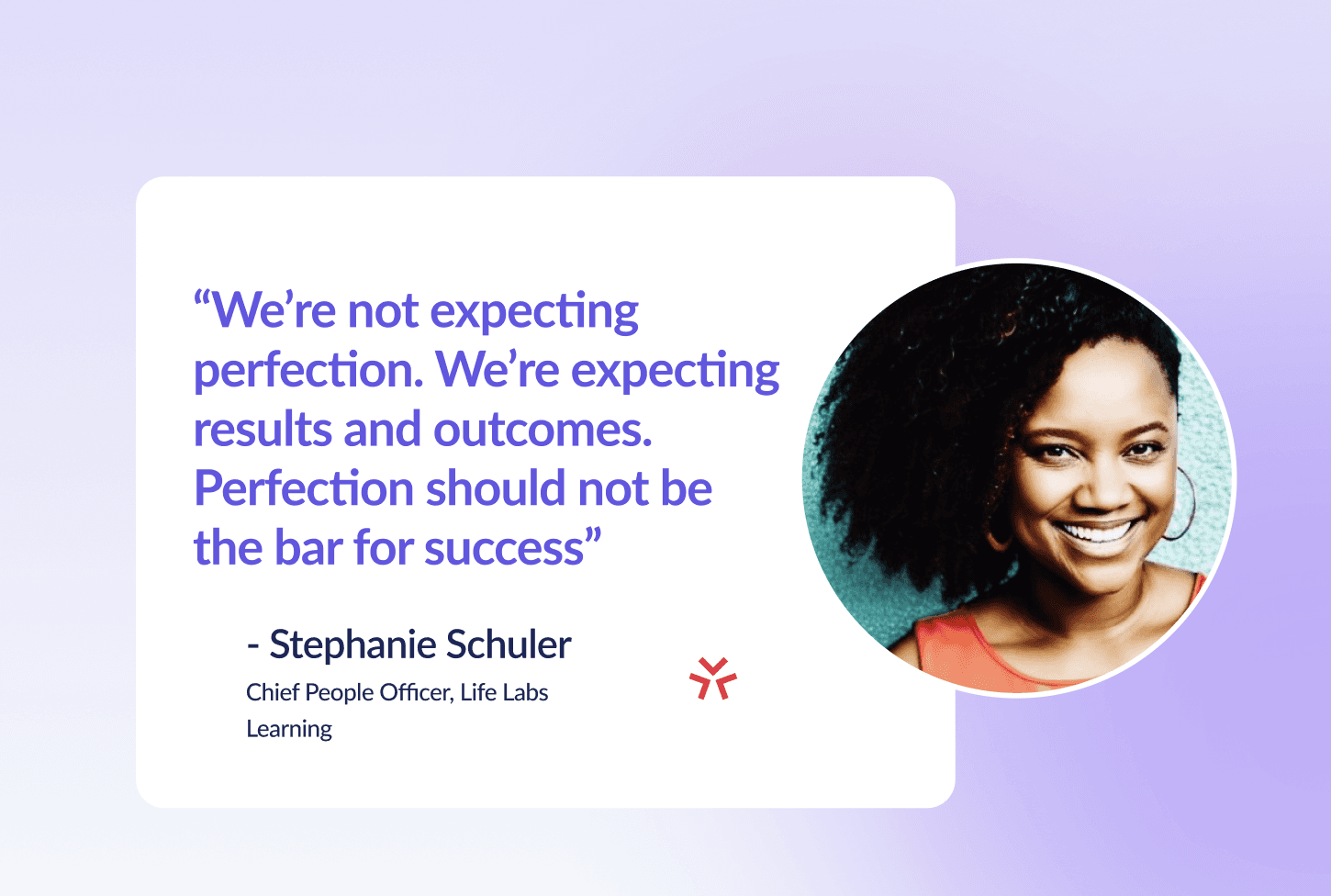
“We’re not expecting perfection. We’re expecting results and outcomes. Perfection should not be the bar for success,” she says.
In a rapidly evolving AI environment, the ability to test, adapt, and improve matters more than avoiding error. But in many performance systems, mistakes are over-indexed. A single misstep can overshadow months of contribution. Feedback focuses disproportionately on what went wrong rather than what is improving.
When mistakes are treated as disqualifying instead of developmental, employees avoid calculated risk. Small errors feel career-threatening. Conversations become defensive. Over time, organizations reward risk aversion instead of innovation. Reframing mistakes does not soften accountability. It clarifies it. The question shifts from “Did you fail?” to “What did you learn, and how did you adjust?” That distinction enables growth.
In many organizations, performance discussions, promotion decisions, and pay adjustments are bundled into a single annual event. That structure magnifies the consequences of error and raises the stakes of every conversation.
“I have a vision for the performance system,” Shuler explains. “If you can separate annual performance reviews from pay rewards, you can have real performance conversations.” You remove the fear.
In her model, performance conversations are ongoing and developmental. Promotion decisions are deliberate and role-based. Compensation responds to meaningful contribution and demonstrated impact, not simply because the calendar turned.
Rewards are predictable, though not uniform or simultaneous. Not every contribution results in an annual merit increase. Not every reward arrives on the same timeline. But expectations are clear. Differentiation is grounded in observable impact. Growth is normalized.
When pay is decoupled from a single high-stakes cycle, feedback loses its existential edge. Managers can coach candidly. Employees can experiment, iterate, and build new skills without fearing that every misstep threatens their standing.
That structure enables iteration.
In an AI-driven landscape, organizations need employees who test, adapt, and refine. This includes managers who can assess evolving roles honestly. Most organizations, however, are not built this way. Manager capability varies. Feedback cultures are inconsistent. Incentive systems sit on top of legacy annual cycles. When accountability, compensation, and development are bundled together, conversations become overloaded and distortion follows.
The work now is not to eliminate differentiation or soften standards. It is to mature the system. Clarify expectations. Train managers. Align recognition with real impact as it happens.
Organizations can still pay for performance. They can still differentiate. Because when compensation responds to contribution instead of being bundled into a single high-stakes ritual, performance conversations become more honest. Adaptability improves and capability compounds.
In a world defined by rapid technological change, Shuler sees that as the true competitive advantage.
Humanizing the AI Work Revolution
Shuler's interview was a clear call to action for HR leaders across industries.
"It is time to breathe some oxygen into the system, as our CEO, David Smith would say. Don't just talk about changing the system but work towards it on a day-to-day basis."
Here's the paradox: the more we automate, the more human we need to be. Algorithms can handle tasks, but they can't build trust, create psychological safety, or have the honest conversations that turn anxiety into action. That's the work of leaders.
We have a choice. We can let fear govern our performance systems and watch culture erode. Or we can follow Shuler's roadmap: communicate change clearly, define the capabilities the future requires, and use performance data not only to identify gaps, but to guide investment. That means rewarding outcomes and treating performance insights as a forward-looking tool for role evolution and capability building, not simply a backward-looking filter for cuts.
The companies that reclaim confidence won't be the ones with the most sophisticated AI. They'll be the ones who remembered that behind every metric and automation decision, there are people who want to grow, contribute, and be valued.
The rubber has met the road. What we do next will define not just the future of work, but the future of leadership itself.
For more Thought Leadership from Stephanie you can find her on Linkedin at https://www.linkedin.com/in/sdshuler and please visit LifeLabs Learning to learn more at https://www.lifelabslearning.com.