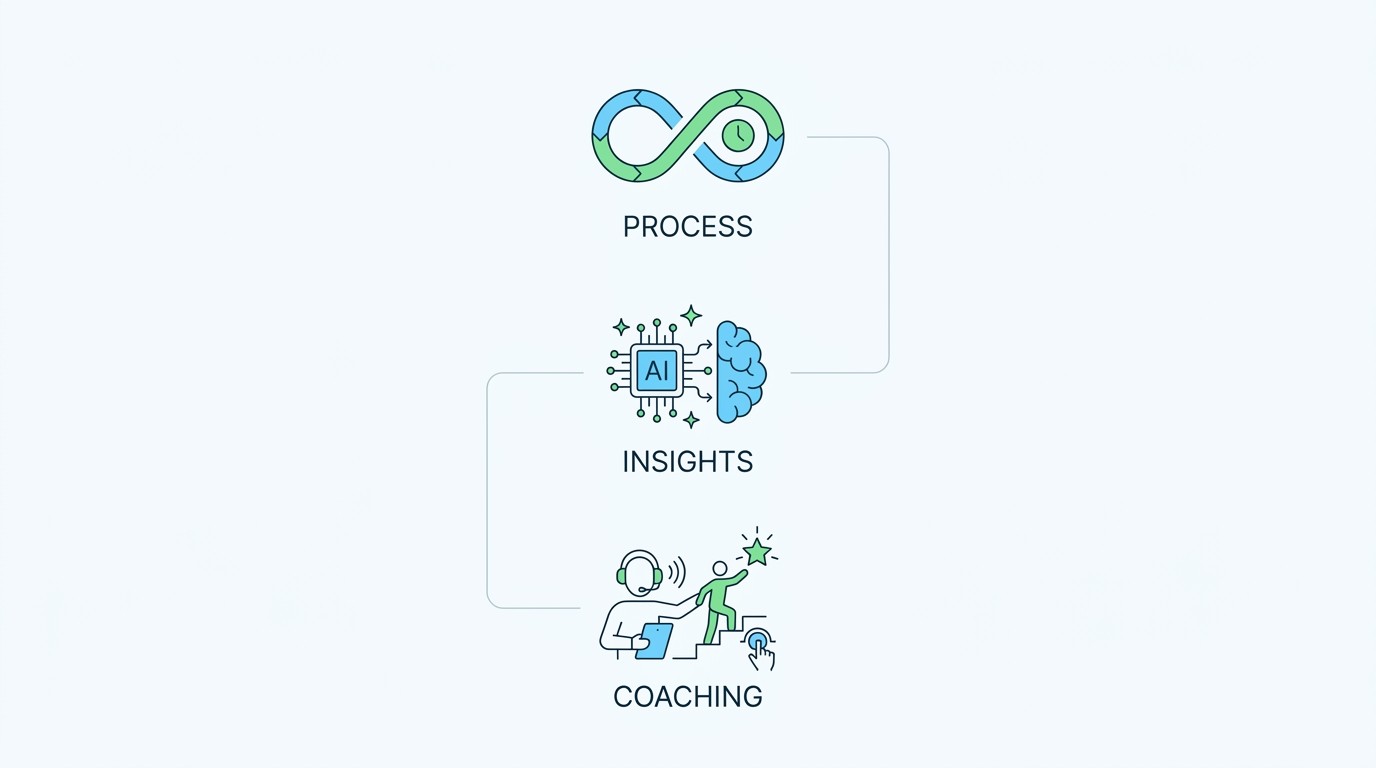
The Role of AI in Continuous Feedback: Automating Insights and Coaching in 2026

Performance management is shifting from episodic evaluation to continuous enablement. Explore the framework for using AI to automate feedback narratives, detect bias, and scale personalized coaching in 2026.

on

The annual performance review is no longer a tool for growth; it is a tombstone for progress. By the time a manager sits down in December to discuss a project from March, the opportunity for behavioral change has long passed. In 2026, episodic evaluation has been replaced by continuous enablement. Managers are drowning in data but starving for the insights that actually move the needle for their teams. Human-led performance management requires a shift toward real-time signals and automated synthesis. This approach ensures that feedback is not a dreaded event but a constant source of competitive advantage. Organizations that fail to automate the friction out of their feedback cycles will lose their best talent to those that do. The technology is here to turn your performance data into a roadmap for growth. That is the standard for the modern workplace. It is time to let go of the annual cycle and embrace the future of continuous coaching.

At A Glance: Why AI is the 2026 Performance Standard

70% of talent executives expect managers to use AI for review development by late 2026.

  • 85% completion rate for AI-driven conversational surveys vs 50% for traditional forms.

  • 30-70% reduction in time spent by managers drafting review narratives.

  • 40% potential productivity increase in HR functions via automated analytics.

  • 89% employee satisfaction in AI-enabled organizations compared to 40% in manual ones.

  • Hybrid Intelligence: The pairing of AI speed with human empathy is the 2026 standard for high-performing teams.

What is AI in Performance Management 2026?

AI in performance management is the use of Natural Language Processing (NLP), machine learning, and predictive analytics to collect and act on performance signals in real-time. This moves organizations from looking back at past mistakes to forward-looking growth systems. According to the Gartner 2025 Performance Management Survey, the value of HR is now measured by the ability to facilitate growth rather than manage administrative cycles. NLP tools synthesize year-round peer recognitions into themes, while predictive models identify turnover risks before they happen. Here is a walkthrough that covers the key coaching trends: https://www.youtube.com/watch?v=yzc9z2WW62Q This transition is critical because efficiency alone does not make a review fair or useful. The primary goal is augmentation where technology handles the heavy lifting of data synthesis, leaving humans to provide the essential context. > AI in performance management means using machine learning to synthesize workforce signals... the goal is augmentation, not replacement. This definition from the MiHCM Complete Guide 2026 highlights the shift toward enablement. By integrating these tools, leaders can ensure that every employee receives the coaching they need exactly when they need it.

6 Ways AI Automates Feedback and Coaching

AI-powered tools automate the most tedious parts of the review cycle while surfacing insights that humans often miss. The following six pillars represent the core of the 2026 performance stack.
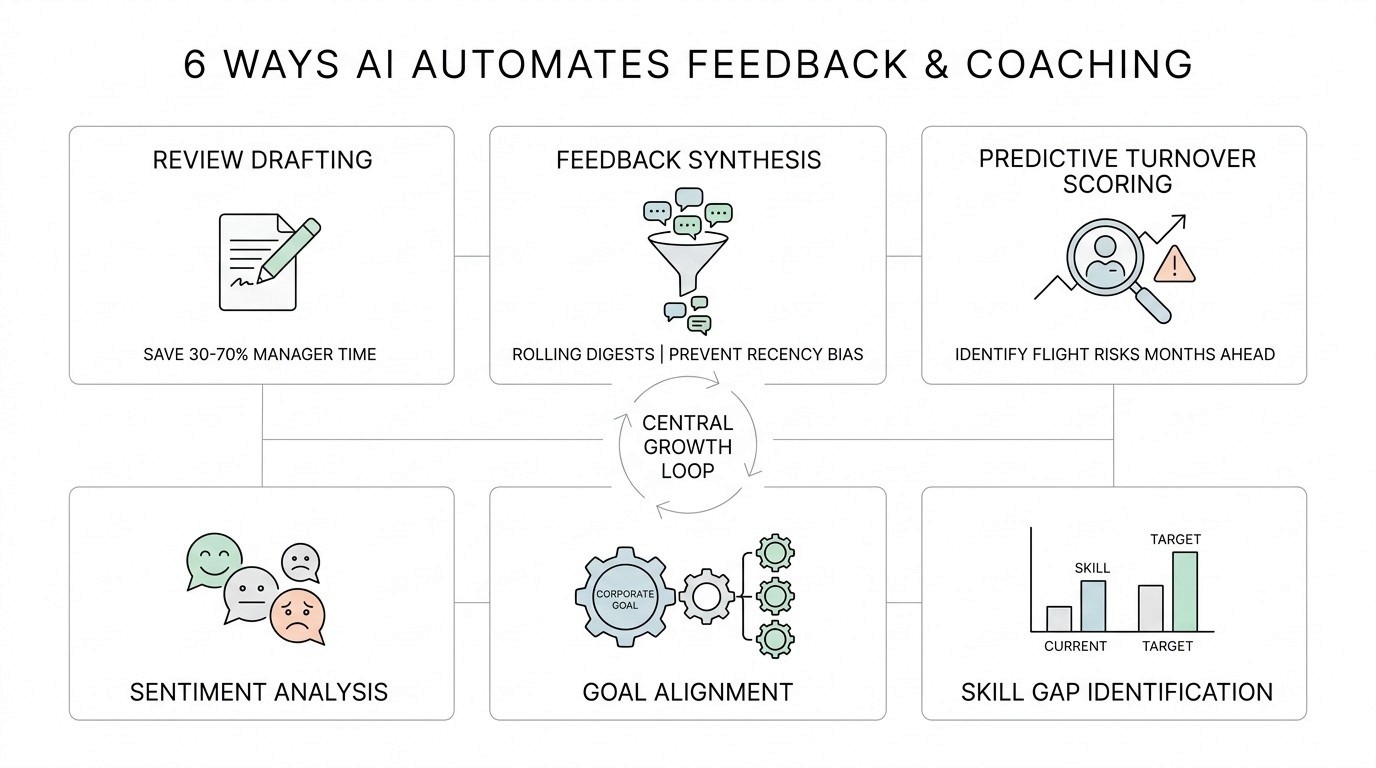
6 Ways AI Automates Feedback and Coaching

1. Review Drafting Automation. AI aggregates year-round notes and goal data to draft initial narratives, saving up to 70 percent of manager time. This allows leaders to focus on mentorship rather than word-smithing documents. The tradeoff is that managers must still edit for tone and specific human context to ensure the message lands correctly. 2. Continuous Feedback Synthesis. Rolling digests of peer and customer feedback are surfaced weekly to prevent recency bias. This ensures that early-year accomplishments are weighted equally with recent project wins. One tradeoff is that occasional outlier comments may require manual filtering to prevent them from skewing the overall sentiment. 3. Predictive Turnover Scoring. Machine learning identifies employees at high risk of leaving months in advance based on shifts in engagement. This provides HR with a proactive window for retention efforts. The tradeoff is that these scores are based on digital signals and cannot account for private life changes. 4. Bias Pattern Detection. NLP identifies inconsistent language or rating inflation across demographic groups during calibration. This makes equity visible to leaders in real-time, allowing for immediate corrective action. The tradeoff is that it only detects biases present in the digital data provided to the system. 5. In-the-flow Coaching Nudges. Contextual prompts are sent to managers before 1:1 meetings based on recent performance data. This turns managers into effective coaches without requiring constant HR intervention. The tradeoff is the potential for notification fatigue if the system is not properly tuned. 6. SMART Goal Generation. AI suggests draft objectives aligned with organizational strategy and role clarity. This ensures that every employee is moving in the same strategic direction. The tradeoff is that employees must stay active in the process to feel true ownership of their targets. Imagine a manager receiving a Weekly Insight Digest that summarizes 15 peer recognitions into three actionable growth themes. Instead of digging through Slack, they walk into a 1:1 with evidence-based coaching points ready to go. This human-led approach ensures that feedback is grounded in reality rather than just memory.

How to Implement AI-Aided Feedback in Your Organization

Implementing an AI-aided feedback system requires a structured 90-day approach to ensure adoption and trust. 1. Audit existing feedback cycles. Identify where delays or memory-based biases occur in your current manual process. This helps you target the highest-leverage areas for automation first. 2. Connect AI tools to daily work platforms. Integrate your performance platform with Slack, Zoom, and your CRM to capture signals in-the-flow. You can use Zal.ai to centralize these data points and configure your entire platform in approximately one week. 3. Set up automated prompts. Configure triggers for feedback after key events like project completions or quarterly milestones. This ensures that feedback is delivered while the behavior is still fresh. 4. Train managers on AI Literacy. Emphasize that AI is a draft assistant and managers remain the final editors. Managers must be comfortable reviewing and contextualizing AI-generated text before sharing it with employees. 5. Launch a 90-day pilot. Focus on one high-leverage area like 360-degree feedback synthesis for a specific department. Use this period to gather feedback and refine the system before a full rollout.

How to Implement AI-Aided Feedback in Your Organization

### How to Build It. To build this system, connect your performance platform to your internal communication tools via API. Configure your AI agent to pull from project management software like Jira or Asana to capture milestones automatically. This setup allows the AI to provide just-in-time nudges based on actual work output. An HR leader uses a calibration dashboard to discover that one department has a 20 percent higher rating average than others despite similar productivity. They use this data to facilitate a conversation during the pilot phase, neutralizing rating inflation before it impacts compensation. - Audit data sources for historical bias. - Establish a clear transparent AI usage policy. - Define manager responsibilities for final review approval. - Monitor response rates for automated feedback prompts. > Tip: Start your pilot with a tech-savvy team that already uses daily communication tools frequently to see the fastest results.

The Human-Led Guardrails: Why Managers Still Matter

The core of the Zal.ai philosophy is that AI should aid humans, not replace them. While technology can synthesize data at scale, it cannot replicate the empathy required for a difficult performance conversation. According to the SHRM AI in Talent Management Report, human oversight remains the anchor for psychological safety. If an employee is struggling due to personal reasons, a manager must have the authority to override automated metrics with compassion. > Rule: AI provides the evidence, but the manager provides the narrative and the final decision. Relying solely on measurable metrics like code commits or ticket counts is a common mistake. This approach ignores soft-skill contributions like mentorship and cultural leadership that AI cannot yet quantify. > Pitfall: Never use automated final scores without a manager review, as this destroys trust and ignores the human context of performance. Zal.ai ensures that managers stay in the driver's seat by providing drafts they can edit and refine. This Hybrid Intelligence model allows for both efficiency and human-centered leadership.

Traditional vs. AI-Enabled Performance Management

Moving from traditional to AI-enabled systems drastically changes the efficiency of your HR team.

Traditional vs. AI-Enabled Performance Management

### Performance System Comparison | Feature | Traditional Reviews | AI-Enabled Reviews | | :--- | :--- | :--- | | Frequency | Annual or Bi-annual | Continuous / Real-time | | Evidence Base | Subjective Memory | Data-Backed Narratives | | Admin Time | High (Hours per employee) | Low (70% reduction) | | Employee Satisfaction | 40% (Low trust) | 89% (High fairness) | | Bias Detection | Manual / Post-mortem | Automated / Real-time | | Goal Alignment | Static / Disconnected | Dynamic / Strategy-linked | This scorecard highlights why organizations are making the switch. Traditional systems rely on the flawed memory of busy managers. AI-enabled systems provide a continuous record of achievement that removes the stress of the annual cycle.

Preparing Your Team for 2026

2026 is the year talent development becomes critical business infrastructure rather than just an HR program. By automating insights and coaching nudges, you allow your managers to focus on building the human relationships that drive performance. Start small by pilot-testing synthesis tools, then scale as your team builds trust in the system. The transition to AI-aided feedback will capture a 40 percent productivity increase for your HR function. Tools like Zal.ai help SMBs transition to this model without losing the human touch. Focus on growth, empower your managers, and let technology handle the data. The future of performance is continuous, fair, and human-led.


Frequently Asked Questions

Does AI replace the manager in performance reviews? No, AI acts as a draft assistant and data synthesizer. The manager's role is to provide context and empathy, which are essential for meaningful growth conversations. ### How does AI help reduce bias in feedback? It uses Natural Language Processing to flag inconsistent language or rating trends across demographic groups. This allows leaders to correct bias during the calibration process rather than after the fact. ### What is the completion rate for AI-driven surveys? Research indicates that completion rates for conversational AI surveys are above 85 percent. This is a significant jump from the 50 percent rates seen with traditional long-form performance surveys. ### Is employee data safe when using these AI tools? Modern platforms prioritize data security and transparency as noted in the Betterworks 2026 State of Performance Enablement. Always ensure your provider has clear usage policies and data protections in place. ### How long does it take to implement these tools? Most modern performance platforms can be configured in approximately one week. The 90-day pilot approach ensures that the culture has time to adapt to the new system.

Explore More Articles