OKRs vs. KPIs in Performance Management: When to Use Each and Why It Matters
Measuring performance shouldn't feel like a math test. We break down the GPS vs. Dashboard framework to help you master OKRs and KPIs without losing your mind.

Most HR tech stacks are graveyards for forgotten metrics. You track everything from average tenure to seat utilization, yet your strategic goals remain stuck in a holding pattern. This is the performance paradox: the more data you collect without a clear framework, the less progress you actually make.
You are likely caught between keeping the lights on and trying to drive the company forward. Most teams fail because they treat every number as equally important, leading to massive burnout and zero strategic movement. This isn't just an admin problem; it is a clarity problem.
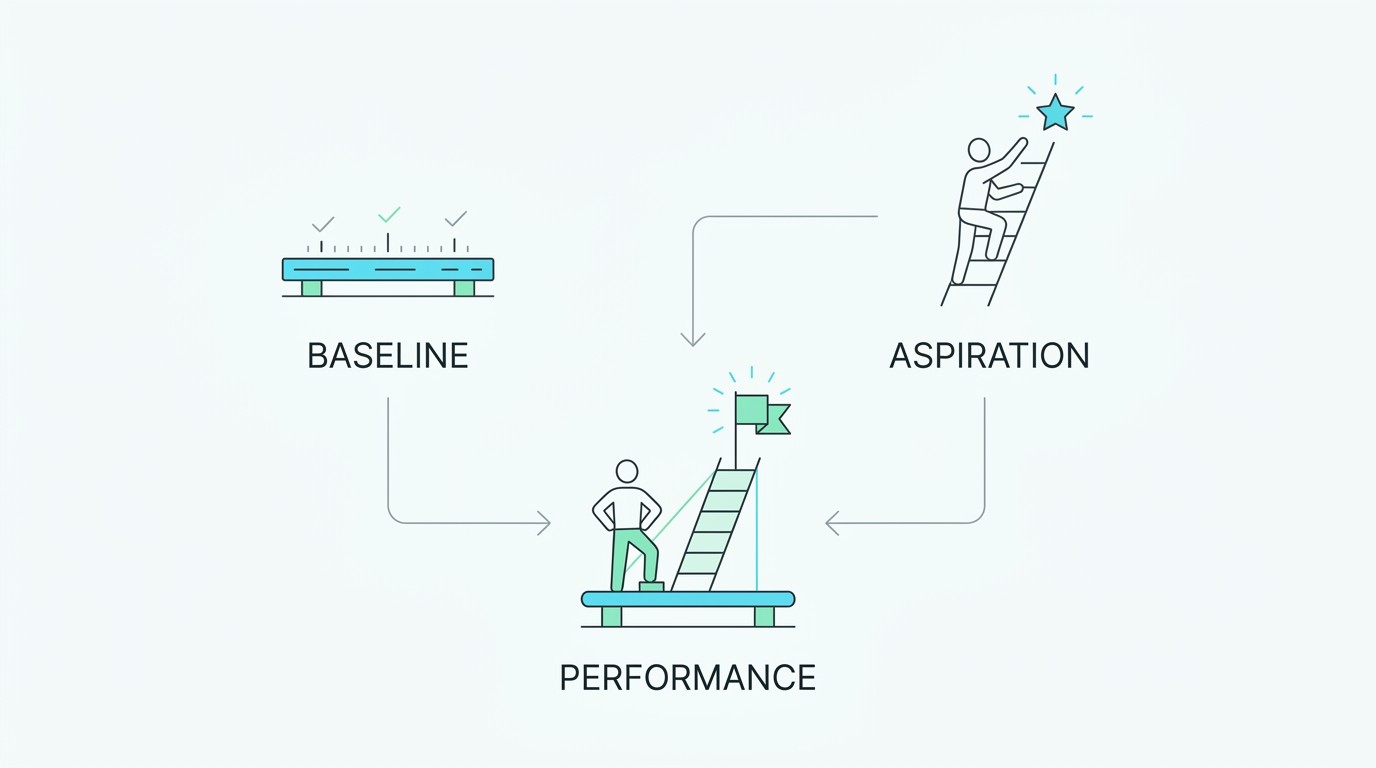
To break the cycle, you must distinguish between the health of your engine and the destination of your car. If you cannot separate what you monitor from what you want to change, your team will keep spinning their wheels.
The Short Version: KPI vs. OKR At a Glance
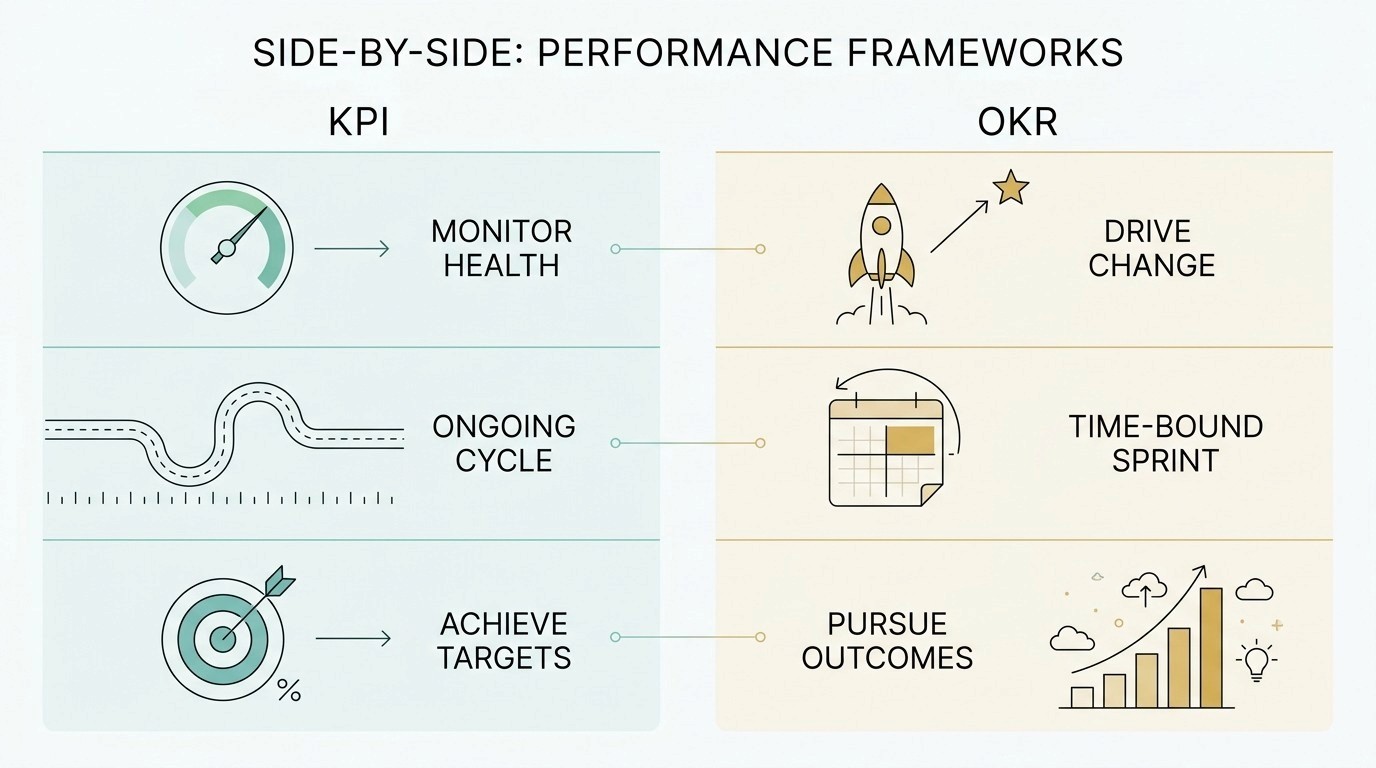
KPIs represent the steady-state health of your business. They tell you if the ship is leaking or if the engine is running smoothly. Success in KPIs is 100% adherence to your defined standard.
Purpose: Monitor stability and ongoing performance.
Timeframe: Continuous and long-term.
OKRs: Drive growth and innovation by breaking trends.
Success in OKRs: Often defined as 70-80% achievement of stretch goals.
Perspective: KPIs tell you how you are doing; OKRs tell you where you are going next.
The Core Definitions: Stability vs. Ambition
Key Performance Indicators (KPIs) are the quantitative metrics that define the health of a specific process. Think of them as your car's dashboard: they show your speed, fuel level, and oil pressure. If a light flashes red, you have a problem that needs immediate attention.
On the other hand, Objectives and Key Results (OKRs) represent your GPS destination. They are a goal-setting framework that pairs an ambitious, qualitative goal with specific, measurable outcomes. While KPIs track business-as-usual, OKRs drive significant, strategic change.
The highest-ROI teams use both in a tight feedback loop. You monitor your dashboard (KPIs) to ensure you don't break down, but you focus your energy on the GPS (OKRs) to reach new milestones. For instance, maintaining 99.9% system uptime is a KPI, while migrating that infrastructure to a new architecture is an OKR.
Comparing the Frameworks
Identify the 'steady-state' (KPI).
Spot a metric that needs a massive shift (The Gap).
Set an ambitious Objective to close that gap (OKR).
Define Key Results to measure the progress (The Proof).
Review the new KPI level once the OKR is complete.
Side-by-Side: Performance Framework Head-to-Head
Choosing the right tool for the job prevents your team from chasing ghost numbers. Use this comparison to decide how to categorize your current priorities.
Feature | KPIs | OKRs |
|---|---|---|
Primary Goal******* | Operational Health | Strategic Growth |
Success Metric******* | 100% Target Met | 70-80% (Stretch) |
Cycle Length******* | Ongoing / Annual | Quarterly / Monthly |
Outcome******* | Stability | Innovation |
KPIs provide the foundation of reliability, while OKRs provide the fuel for your next major breakthrough. Without KPIs, you might achieve your goals but destroy your culture or budget in the process.
HR Listicles: Examples You Can Steal for 2026
Applying these frameworks to HR requires moving past generic spreadsheets. Here is how you can implement these in your performance cycles using a modern platform like Zal.ai.
Time-to-Hire
This KPI maintains the efficiency of your recruiting engine. You might set a standard to keep this under 30 days to ensure the business stays staffed.
Implementation: Use your ATS data to monitor the average days from job posting to offer acceptance.
Tradeoff: Focusing solely on speed can lead to lower quality of hire if not balanced with other metrics.
Modernize the Screening Process
This OKR is an objective aimed at changing how you hire. If your Time-to-Hire is consistently high, this project aims to fix the root cause.
Implementation: Implement an AI-driven tool to automate initial resume screening and reduce recruiter manual labor.
Tradeoff: Requires significant upfront time for setup and training before seeing results.
eNPS (Employee Net Promoter Score)
Use this as a steady-state KPI to track employee satisfaction over time. It acts as an early warning system for cultural issues.
Implementation: Run a single-question survey every quarter through Zal.ai Engagement Surveys.
Tradeoff: It tells you how people feel, but it doesn't always explain why they feel that way.
Implement AI-Driven Feedback Loops
This OKR aims to reduce administrative overhead and improve review quality within a specific quarter.
Implementation: Wire Zal.ai 360 Reviews into your Slack workflow to collect real-time data.
Tradeoff: Some managers may initially resist moving away from traditional annual spreadsheets.
Consider a Head of People at a 200-person tech firm who noticed that while Time-to-Hire was stable, new hire performance was plummeting. By shifting the focus from the KPI to an OKR centered on 'Revamping Onboarding Experience', they reduced 90-day turnover by 15% within two quarters.

Tip: Never turn your entire job description into OKRs. Keep 80% of your work in the KPI 'monitor' zone and use OKRs for the 20% that requires growth.
The Human-Led Playbook: How to Combine Both Frameworks
Combining these frameworks doesn't have to be a headache. The goal is to move from 'What are you doing?' to 'How can I unblock you?' by using AI to handle the data collection while you handle the coaching.
A human-led approach ensures metrics serve people, not the other way around. Follow this sequence to integrate both into your next cycle:
Audit your current metrics: Identify 5-7 core KPIs that define your department's basic health.
Find the friction point: Review your KPI performance to find one metric that needs a significant shift.
Draft the Objective: Write a qualitative statement describing the future state once that metric is fixed.
Set the Key Results: Define 3-5 measurable outcomes that prove you are moving the needle.
Sync with 1:1s: Use Zal.ai Continuous Feedback to discuss KPI health and OKR progress every week.
Use KPIs to flag immediate operational issues during check-ins.
Use OKRs to drive accountability for long-term growth projects.
Ensure every OKR has a single owner to prevent diffusion of responsibility.
Review quarterly to see if a successful OKR should now become a standard KPI.
Use AI tools to summarize feedback trends so managers can focus on the human conversation.
Zal.ai reduces performance review admin by 50% by centralizing these narratives automatically. This allows you to spend less time auditing the past and more time unblocking the future.
When to Use What: The 4-Question Decision Matrix
Not every task needs to be an OKR. Use these decision rules to decide where a new initiative belongs in your system.

If you need to maintain a standard or monitor ongoing health, then create a KPI.
If you need to break a trend or launch a new initiative, then create an OKR.
If a KPI falls out of a healthy range for more than two months, then create an OKR to address the root cause.
If an initiative is 'Business As Usual' (BAU), then do not list it as an OKR.
Setting too many OKRs dilutes your focus and confuses your team. Keep your strategic priorities to a maximum of three to five per quarter to ensure they actually get done.
Avoid These Common Metric Meltdowns
Even the best frameworks fail if they are applied too rigidly. Organizations using structured frameworks like OKRs are 39% more likely to achieve their goals, but only if they avoid common pitfalls.
The BAU Trap: Using OKRs to track daily tasks rather than strategic shifts.
The 100% Fallacy: Penalizing employees for hitting 70% of a stretch OKR.
The Ownership Gap: Failing to assign a single owner to every Key Result.
Metric Fatigue: Tracking 20+ KPIs when only 5 actually matter for health.
Pitfall: If your team is burnt out, KPIs become irrelevant. Focus on the person before the project to avoid systemic collapse.
Success requires frequent resets rather than set-and-forget mentalities. If a goal no longer serves the company's direction, have the courage to kill it mid-quarter.
Stop Auditing, Start Leading
Effective performance management isn't about counting every step; it is about making sure those steps lead somewhere meaningful. By balancing KPIs for health and OKRs for growth, you give your team the clarity they need to perform.
The highest-ROI 1:1s move from auditing to leading. You stop asking what people did and start asking how to unblock their progress. This shift changes the entire cultural dynamic from surveillance to support.
Take the first step by auditing your dashboard today. Identify your 'vital sign' KPIs and pick one strategic OKR to pursue this quarter. That focus is what separates stagnant teams from high-growth organizations.
Common Questions About Performance Frameworks
What is the biggest difference between KPIs and OKRs?
KPIs measure the success of an ongoing process or activity, while OKRs focus on achieving specific, ambitious goals that drive change. Think of a KPI as a 'health check' and an OKR as a 'growth spurt'.
Can a KPI become an OKR?
Yes. If a steady-state KPI like 'Employee Turnover' starts trending in the wrong direction, you might create an OKR like 'Redesign Career Development Paths' to fix the underlying issue.
How many OKRs should a manager set?
Most experts recommend 3 to 5 Objectives per quarter, with 3 to 5 Key Results each. Any more than that usually leads to a loss of focus and poor execution quality.
Do OKRs replace performance reviews?
No. OKRs are a goal-setting tool, while performance reviews evaluate an individual's overall contribution and behavior. Using a platform like Zal.ai helps connect your OKR data directly into the review process for a more objective evaluation.