Mastering Continuous Feedback for Remote and Hybrid Teams: 2026 Best Practices
Traditional annual reviews are failing distributed teams. This 2026 playbook details how to implement continuous feedback loops that drive engagement and mitigate proximity bias.

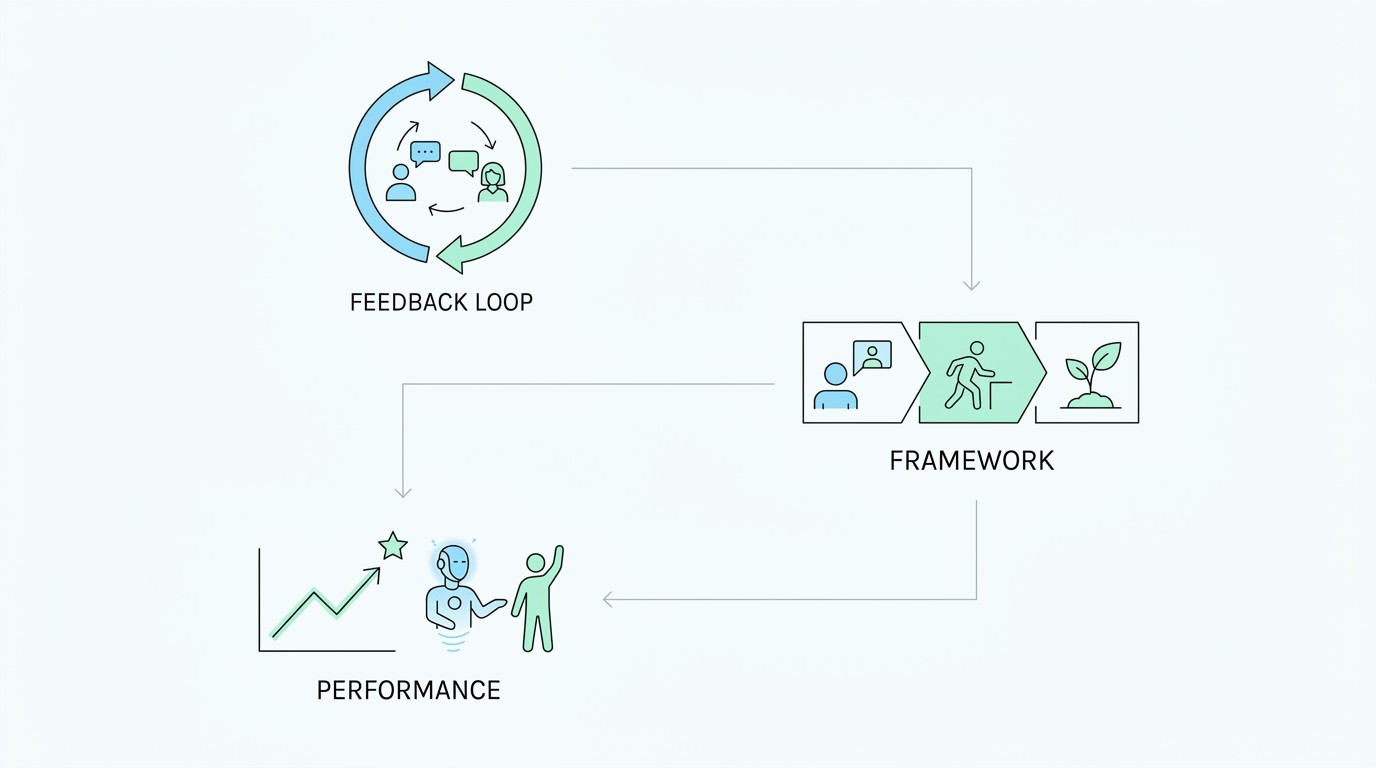
Traditional appraisals were designed for people in-person work. When that visibility disappears, the feedback loop must become the infrastructure itself rather than an occasional event. Feedback is the most effective way to prove to a remote worker that their output actually matters to the organization.
Statistics show that 66% of employees strongly dislike traditional annual performance reviews. This sentiment is amplified in remote settings where the distance makes a formal, backward-looking grade feel arbitrary and disconnected from daily reality. Without intentional intervention, managers default to checking status lights rather than evaluating impact.
The real danger is the feedback desert. This is a state where remote employees receive nothing but transactional instructions for months on end. A feedback desert is the primary driver of the 'quiet quitting' phenomenon in distributed teams.
When employees do not know where they stand, they stop taking risks. They stick to the safest, most visible tasks to ensure they are perceived as 'busy.' This behavior kills innovation and turns your high-performers into clock-watchers.
Remote work has not changed the fundamental human need for recognition and course correction. It has simply changed the requirement for intentionality in how we deliver it. In 2026, the difference between busy teams and high-performing ones comes down to how well their tools connect planning, collaboration, and execution.
We must move away from the idea that feedback is a 'special conversation' scheduled for a Friday afternoon. It should be as integrated into the workflow as a pull request or a project update. If it feels like an interruption, you are doing it wrong.
Intentional feedback loops bridge the physical visibility gap. They act as the pulse of the company, ensuring that even if we never meet in person, we are moving in the same direction. Without a continuous loop, your remote culture is just a collection of individuals working in separate silos.
Consider the psychological cost of silence. A remote developer spends three days on a complex refactor and hears nothing but 'thanks' in a chat thread. They have no idea if the quality met expectations or if they should have focused elsewhere. Over time, this lack of clarity erodes the sense of purpose.
We are seeing a shift toward 'operational infrastructure' in performance management. This means the system tracks progress and prompts conversations automatically, so managers do not have to rely on their own memory or calendar reminders. Modern performance systems ensure that no employee becomes a ghost in the machine.
Building this culture requires more than just a new software tool. It requires a fundamental shift in how we define a manager's role. Managers are no longer taskmasters; they are coaches who provide the context and correction needed for autonomous success. Success in 2026 is measured by how quickly a team can adapt based on real-time data.
The physical visibility gap is the greatest threat to remote productivity.
Transactional communication is not a substitute for performance coaching.
Silence from leadership is interpreted as apathy by remote employees.
High-performance culture is a product of frequent, low-stakes course corrections.
The goal is to create a 'no surprises' environment. By the time a formal review cycle rolls around, the employee should already know every single point that will be discussed. Consistency in feedback is the ultimate cure for the anxiety of remote work.
2026 Feedback Fast-Track
Shift to Outcomes: Replace 'hours logged' with specific deliverables and quality metrics to ensure remote-hybrid equity.
Human-Led, AI-Aided: Use AI to summarize themes and suggest coaching nudges while keeping managers in the driver's seat.
Layered Cadence: Establish a rhythm of weekly recognition, biweekly alignment, and monthly development deep-dives.
Communication Charter: Define clear rules for which feedback belongs in Slack versus a dedicated performance platform.
SBI Framework: Train managers to use Situation-Behavior-Impact scripts to keep remote feedback objective and actionable.
Why Continuous Feedback is Non-Negotiable in 2026
In 2026, measuring 'presence' is a dead strategy. Remote teams thrive when management shifts from activity-based metrics (like Slack activity) to outcome-based evaluations.Companies that implement regular feedback loops see a 14.9% reduction in turnover rates.
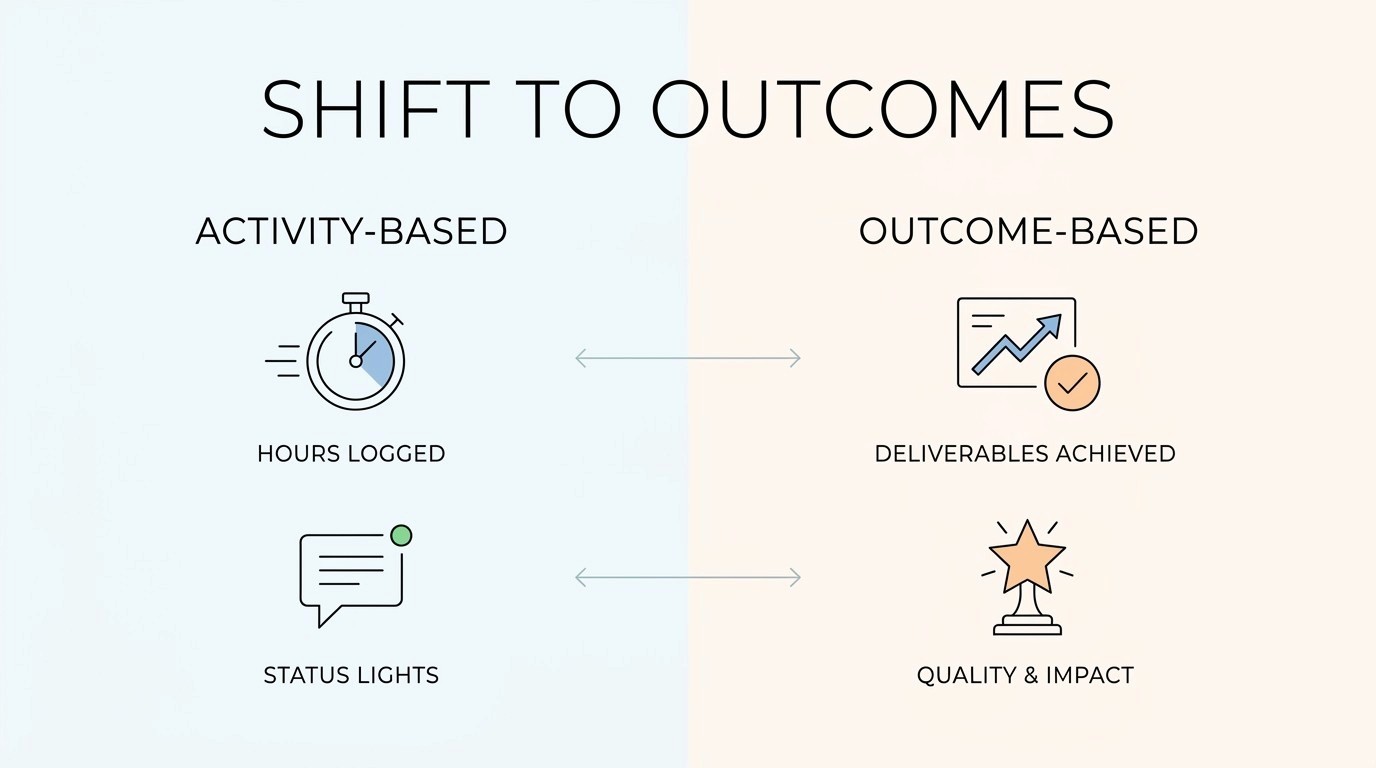
Outcome-based models focus on the 'what' and 'why' rather than the 'how many hours'. This approach prevents the burnout associated with remote workers feeling they need to be 'always on' to prove their value.
Step 1: Build the Psychological Safety Infrastructure
Trust is the primary currency of a distributed team. Without psychological safety, employees will view feedback as a digital trail of evidence for their eventual termination. Transparency about how you use data is the first step in building this safety. Employees will not offer honest feedback unless they trust the system is for growth, not punishment.
To build this infrastructure, start by creating a 'Communication Charter'. This document should explicitly state where feedback lives to prevent it from getting lost in transient chat apps.
Use Slack/Teams for immediate recognition and 'Kudos'.
Use a centralized performance platform for documented check-ins.
Use video calls for any feedback that could be misinterpreted in text.
Maintain a 'no-surprises' policy by logging feedback close to the event.
Transparency about data use builds confidence in your system. This clarity then allows remote workers to focus on their output rather than worrying about invisible metrics.
Step 2: Sync Your Feedback Loops
A consistent cadence is the heartbeat of a remote organization. You cannot rely on organic 'watercooler' moments to course-correct performance in a hybrid world.
Rule: Never skip a scheduled 1-on-1, even if you feel there is 'nothing to report' as these sessions maintain the connection baseline.
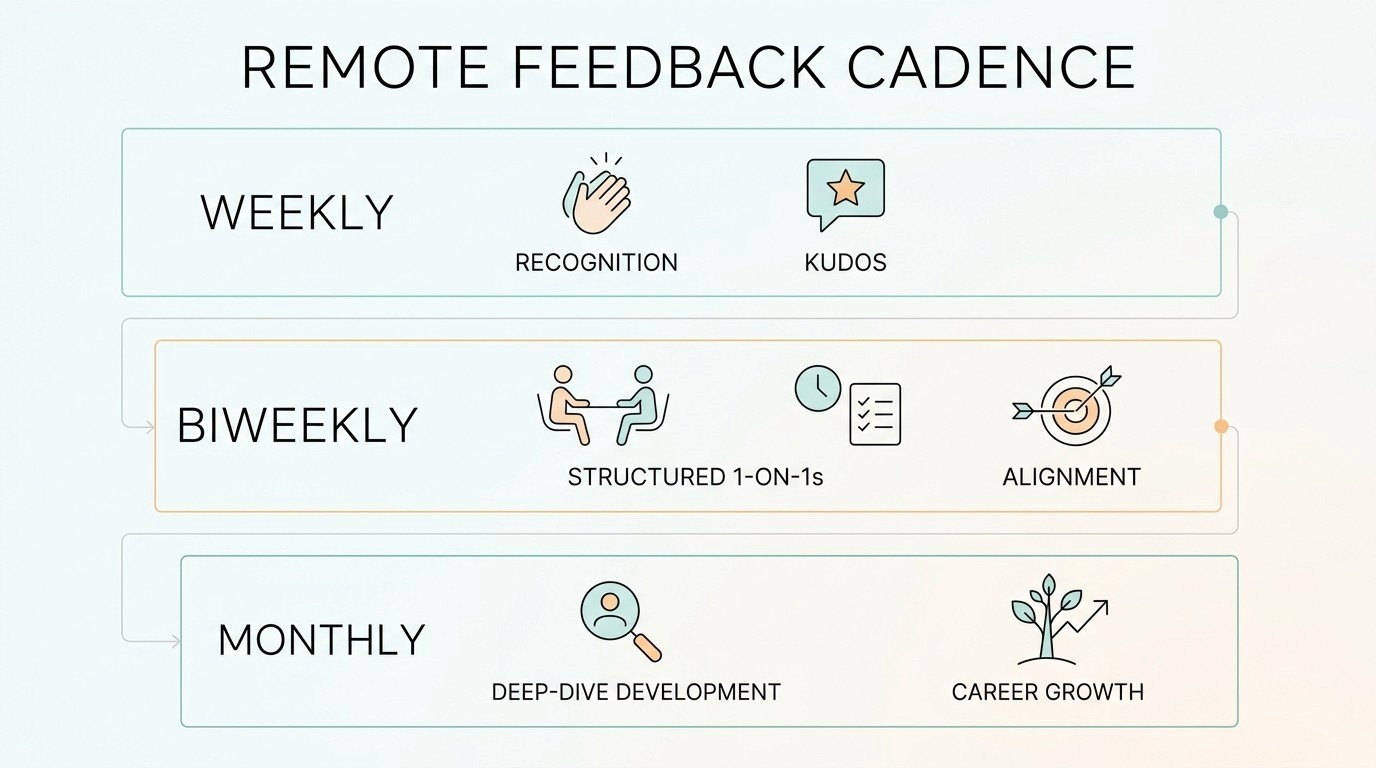
Weekly: Real-time recognition and brief standups to celebrate small wins and clear immediate blockers.
Biweekly: Structured 1-on-1s focused on goal progress and tactical alignment using your preferred performance platform.
Monthly: Dedicated development chats that are strictly separated from daily task discussions to focus on long-term career growth.
Quarterly: High-level review of feedback themes and KPI alignment to adjust the team's broader strategy.
A multi-layered cadence ensures that feedback is both timely for the work and meaningful for the career. This structure prevents the 'recency bias' that often plagues annual reviews.
Step 3: Leverage Human-Led, AI-Aided Technology
Modern HR leaders at companies with 50-500 employees are moving toward 'human-led, AI-aided' systems. Tools like Zal.ai are designed to centralize this process, reducing the administrative burden that usually kills feedback initiatives.
AI serves as a map, while the manager stays in the driver's seat. For instance, AI agents can gather 360-degree feedback from multiple sources and summarize them into actionable coaching themes.
Defeating Proximity Bias in Hybrid Environments
Proximity bias is the 'silent killer' of hybrid equity. It occurs when managers subconsciously favor the employees they see in person over those they only interact with via a screen.
To defeat this, you must insist on a 'digital first' documentation policy. Every performance signal must be recorded in a central platform like Zal.ai to ensure remote employees are seen and recognized fairly.
Pitfall: Relying on 'transient chat' (like Slack or Teams) for performance documentation makes it impossible to track growth over time.
Implement calibrated 360-degree reviews to protect remote peers. This involves gathering feedback from a diverse group of coworkers to provide a balanced view that counteracts any individual manager's proximity bias.
The Remote Manager’s Script: Mastering the SBI Framework
The Situation-Behavior-Impact (SBI) framework is the most effective tool for remote managers. It strips away the vagueness of text-based feedback and focuses on objective reality.
Tip: When delivering constructive feedback to a remote worker, always opt for a video call to ensure your tone and body language are not misinterpreted.
Example
Situation: During Tuesday's client presentation on Zoom.
Behavior: You interrupted the client twice while they were explaining their budget constraints.
Impact: It made the client hesitant to share further details, which delayed our project timeline by a week.
Using the SBI framework ensures that feedback remains non-punitive and focused on specific professional growth. It removes the 'personal' sting and replaces it with a clear path for improvement.
The Future of Remote Performance is Continuous
The transformation of performance management from a yearly 'event' to 'operational infrastructure' is the hallmark of successful remote teams. Adobe saw a 30% increase in engagement scores after replacing annual reviews with continuous check-ins.
This shift removes the stress of 'surprises' and builds a foundation of trust that is essential for distributed work. By integrating feedback into the daily workflow, you turn performance management from a burden into a competitive advantage.
Remember that humans stay in the driver's seat while AI provides the data and the map. Modern tools allow you to focus on the human element of coaching while the system handles the administrative heavy lifting.
Start by assessing your current feedback cadence. Move toward a more frequent, outcome-based model to ensure your remote team remains engaged, aligned, and visible in 2026.