Managing Distributed Teams: A Step-By-Step Guide to Drive Performance in 2026
In 2026, managing remote performance requires more than just Zoom calls. This playbook explores how unified software and AI-driven metrics are replacing static reviews to drive 16% productivity gains.

Why Static Reviews Are Failing The Modern Workforce
The annual review is officially a relic of a slower era. By 2026, over 36 million Americans work primarily from home, reducing visibility and making the once-a-year feedback cycle dangerously slow. Static reviews fail to capture the reality of daily output in a distributed environment. This delay creates a visibility gap where high performers feel ignored and struggling employees drift into burnout.
Modern performance management relies on a real-time ecosystem. We have moved from proximity bias to a culture of shared context where progress is tracked in living documents and decision logs. This ensures everyone is measured by the value they create rather than their ability to stay online.
Step 1: Unify Your Performance Tech Stack
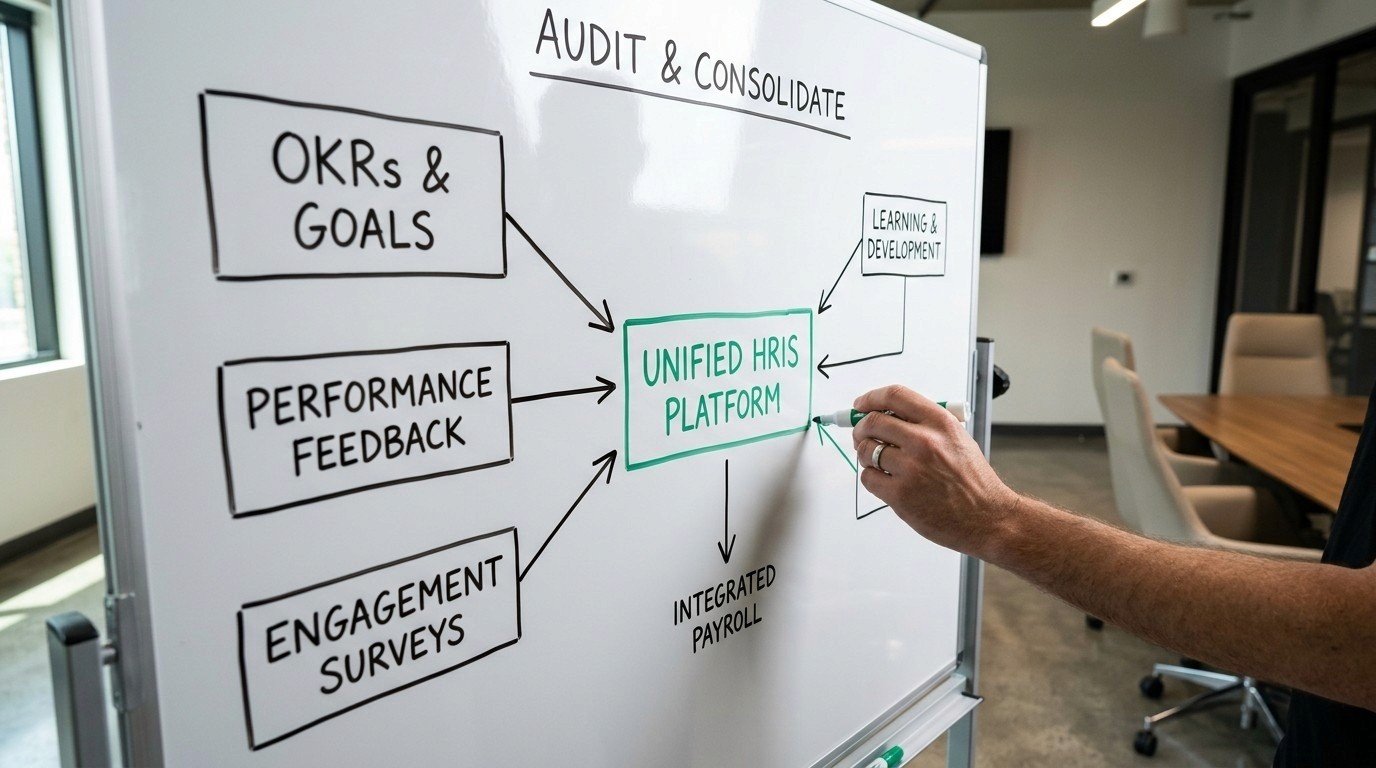
Start by auditing your current tech stack for redundancy. Most distributed teams suffer from app sprawl, where important information is scattered across multiple softwares.
Aim for one unified platform that connects your OKRs, performance reviews, and workforce analytics. This centralization eliminates fragmented data and ensures a single source of truth for every employee.
Step 2: Transition To Outcome-Based Metrics
The fastest way to destroy trust in a remote team is through keystroke tracking. In 2026, the gold standard is the quality of AI-augmented output and milestone completion.
Stop measuring hours logged and start measuring project velocity. This shift empowers employees to own their schedules and focus on deep work windows. If a task can be measured by time alone, it is likely a candidate for automation rather than a human KPI.
Remote work success is achieved by protecting deep work windows and treating focused output as the primary metric of success. When you focus on what gets finished, the 'where' and 'when' become irrelevant.
Step 3: Deploy AI For Burnout And Focus Tracking
AI reduces review prep time significantly by synthesizing feedback loops into actionable summaries. This allows managers to spend their time on coaching rather than administrative data entry.
Consider the scenario of a senior lead at a global firm whose focus hours dropped sharply over two weeks. Instead of a performance warning, the system flagged a burnout risk, allowing the manager to provide a mental health break before the employee quit.
Step 4: Formalize Asynchronous Feedback Loops
Asynchronous work is the only way to scale distributed performance without causing meeting fatigue. High-performing teams prioritize decision logs and searchable handbooks over constant video calls.
Establish a documentation-first culture where every major decision is written down. This allows team members across different time zones to stay aligned without waiting for a synchronous meeting.
Integrate continuous feedback loops directly into your communication tools.
Create a centralized team handbook that defines collaboration norms and communication expectations.
Use video messages for nuance and documents for technical specifications.
Reward employees for contributing to shared context rather than just sending high message volumes.
Verification Checklist: Is Your Strategy Working?
A successful distributed strategy requires constant verification of your internal systems. If your data is siloed or your managers are overwhelmed, the system is failing.
Every individual OKR must roll up to a larger company strategy for the team to remain focused. Regular audits ensure that your technology is serving your people rather than creating more work.
Every major team decision is logged in a central, searchable document.
Employees can view their progress against company-wide OKRs in real-time.
Managers spend less than one hour preparing for performance reviews due to AI synthesis.
Focus time metrics are used to protect employees from burnout rather than for punishment.
Your unified platform automatically syncs performance data with compensation cycles.
Leading The 2026 Distributed Frontier
Trust is no longer a soft skill; it is a competitive advantage in the 2026 economy. Distributed teams that master unified software and outcome-based metrics outpace their competitors by focusing on what truly matters.
The era of monitoring is over and the era of enablement has begun. By leveraging AI to protect focus time and unifying your data, you build a resilient, high-performing culture. Your team's performance depends on the shared context you build today.