Actionable Continuous Feedback Examples for Managers and Employees
Ditch the annual review anxiety. Explore specific, real-world continuous feedback examples designed to boost engagement and drive high-performance cultures.

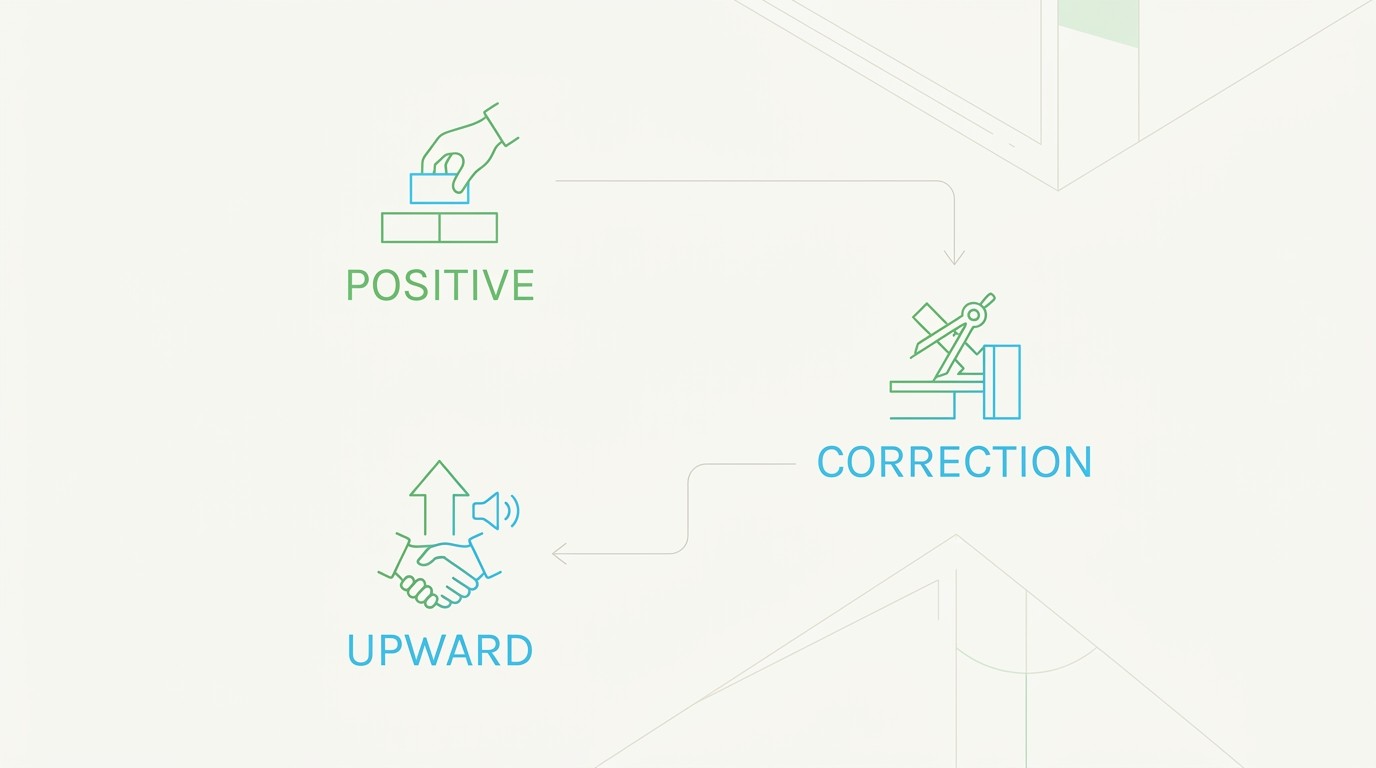
Modern work moves too fast for these delayed 12-month feedback cycles. As opposed to this, continuous feedback creates real-time loops that allow teams to course-correct before small issues turn into systemic failures. It is the difference between high-performance and underperformance.
Stop saving the conversation for December. If you want to drive performance today, you need a system that captures insights as they happen.
The Bottom Line on Real-Time Feedback
Companies that embrace continuous performance management see a massive boost in productivity compared to those stuck in traditional cycles. It is a competitive advantage that changes how teams operate on a daily basis.
Regular feedback loops reduce burnout significantly because employees feel heard and supported by their managers. This can be achieved through a human-led, AI-aided approach that ensures managers have the right phrasing and data at their fingertips without losing the personal connection that builds trust.
The Framework: How to Structure Every Feedback Moment
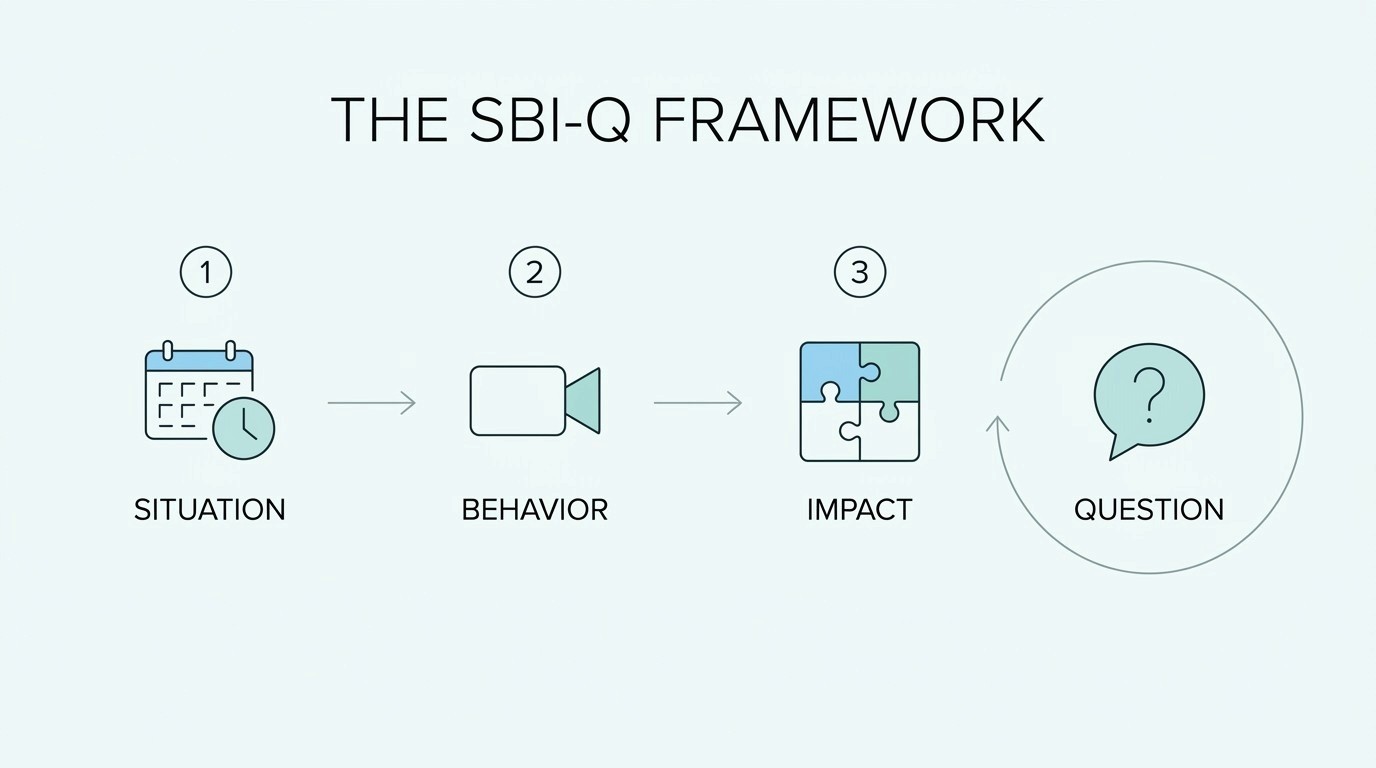
Feedback should be a dialogue, not a lecture. The framework ensures you stay objective and open the door for a two-way conversation.
Situation: Specify the exact time and place of the event.
Behavior: Describe what you observed using straightforward, objective facts only.
Impact: Explain the business or team consequence of the behavior.
Question: Ask an open-ended question to uncover context you might be missing.
Example
Situation: During the Tuesday client presentation.
Behavior: You identified the data error in the final slide before the client saw it.
Impact: This protected our reputation for accuracy and saved the project timeline.
Question: How did you manage to catch that discrepancy so late in the process?
Understanding how to deliver this effectively is a core leadership skill.
10 Examples for Constructive Correction and Accountability
Correction is an investment in an employee's future. When handled correctly, it strengthens the professional relationship rather than damaging it.
1. The 'Front Door' Approach
Script: "I have noticed the quality isn't where we need it, but I can tell you want to succeed. I want to help. Can we discuss options?"
Why it works: It establishes positive intent and safety immediately.
Execution: Use this for high-performers who are suddenly slipping.
2. Deadline Management
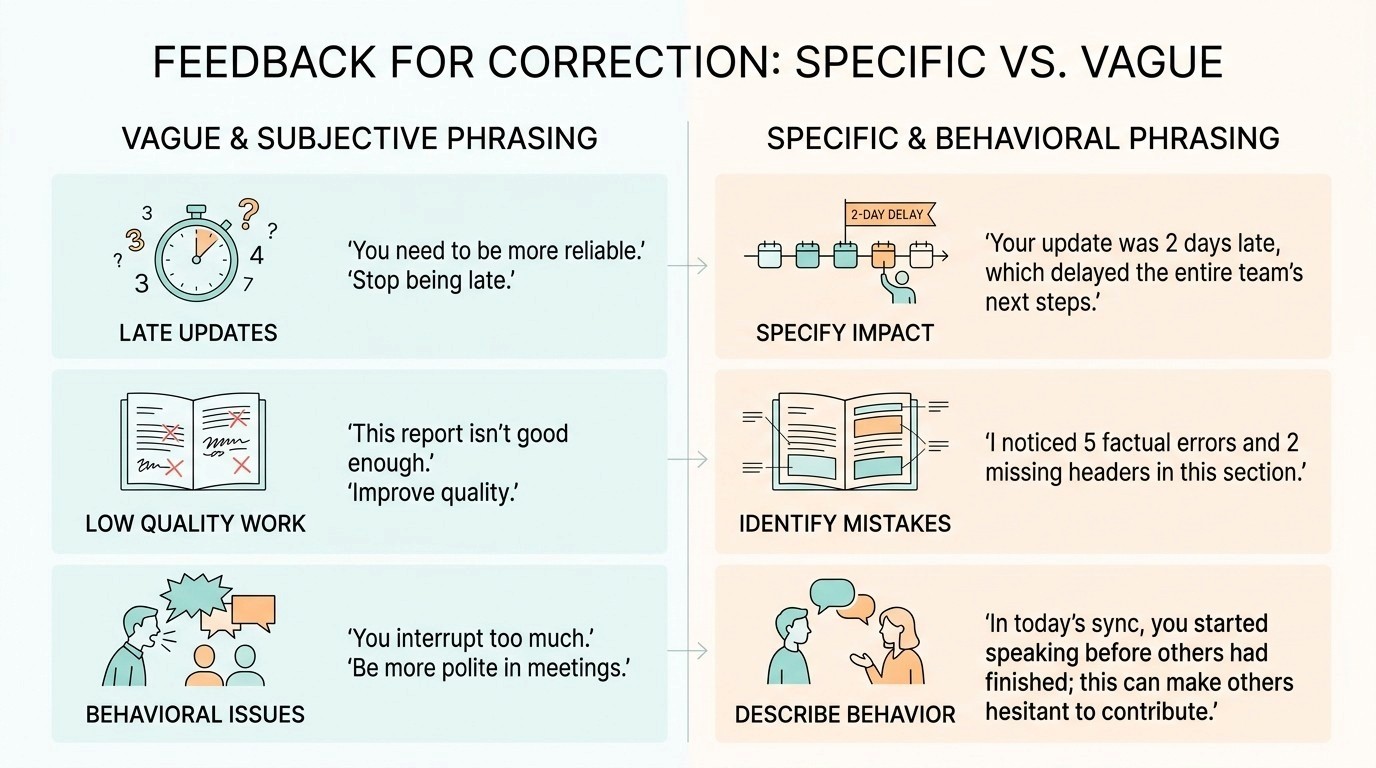
Script: "When weekly updates are delayed, the rest of the team cannot move forward. Let's set a reminder so your reports hit on time."
Why it works: It explains the 'ripple effect' of their delay on others.
Execution: Set up a recurring automated prompt in Zal.ai to assist them.
3. Meeting Etiquette
Script: "In today's sync, you started speaking before others finished. This can make the team feel their ideas aren't heard."
Why it works: It addresses behavioral friction that kills psychological safety.
Execution: Discuss this privately in a 1:1 rather than in the meeting.
4. Over-Committing
Script: "I see you took on three extra tasks this week. Your core deliverables are falling behind because of it."
Why it works: It corrects the misconception that 'more work' is always better.
Execution: Use a SMART goal tool to realign their priorities.
5. Tone in Digital Communication
Script: "Your Slack message to the design team came across as blunt. It might be helpful to lead with context next time."
Why it works: It bridges the gap between intent and impact in async work.
Execution: Offer a quick template for future requests.
6. Attention to Detail
Script: "There were several typos in the final proposal. This affects how the client perceives our professionalism."
Why it works: It links a 'small' error to a 'large' business risk.
Execution: Suggest a secondary review process for all final assets.
7. Ownership of Mistakes
Script: "When the project failed, the team needed you to lead the debrief. Shifting blame made them feel unsupported."
Why it works: It addresses leadership and accountability gaps directly.
Execution: Set a goal for them to lead a 'lessons learned' session.
8. Resistance to Change
Script: "I've noticed you're still using the old template. Switching to the new system ensures our data remains consistent."
Why it works: It focuses on the 'why' behind the new process.
Execution: Provide a 15-minute screen share to show them the new flow.
9. Lack of Initiative
Script: "I've noticed you tend to wait for instructions on every step. For this role, I’d love to see you take the initiative to start proposing the next moves yourself."
Why it works: It clarifies the expectation for autonomy.
Execution: Assign a small project where they have full decision rights.
10. Collaboration Gaps
Script: "You completed your part of the code, but didn't document it for the QA team. This created a bottleneck for the release."
Why it works: It highlights the importance of hand-offs in a workflow.
Execution: Add a 'Documentation' step to their standard task checklist.
10 Examples of Upward Feedback for Managers
Upward feedback is essential for a healthy culture. It holds managers accountable and ensures the team has the support it needs to deliver.
If your manager is micro-managing, then suggest a 'weekly results summary' to build trust without constant check-ins.
If your manager is too busy to provide guidance, then request a recurring 15-minute sync to align on priorities.
If your manager changes priorities frequently, then ask for a 'prioritization matrix' to understand which tasks to drop when new ones arrive.
1. Requesting Clarity
Script: "I know you're busy, but more regular check-ins would help me deliver results with less guesswork."
Why it works: It frames the request as a way to improve output quality.
Execution: Suggest a specific time or tool for these check-ins.
2. Prioritizing Workload
Script: "Can we regroup to align on current priorities? I just want to make sure we’re on the same page."
Why it works: It helps the manager see the capacity limits of the team.
Execution: Bring a list of your current tasks to the meeting.
3. Seeking Timely Feedback
Script: "Is there any way we can expedite the feedback process?"
Why it works: It sets clear expectations for the manager's role in the process.
Execution: Use a project management tool to track review status.
4. Improving Meeting Efficiency
Script: "I've noticed our syncs often run over time. Could we start using a shared agenda to keep us on track?"
Why it works: It offers a solution-first approach to a common pain point.
Execution: Create a simple template in Notion or Google Docs and share it.
5. Managing Communication Styles
Script: "I find it difficult to track tasks sent via Slack. Could we keep project-related requests in our tracking tool?"
Why it works: It helps you maintain a 'single source of truth' for your work.
Execution: Be consistent in moving Slack requests to the tool yourself as a prompt.
6. Asking for Recognition
Script: "I put a lot of effort into the Q3 report. It would be helpful to know which parts you found most valuable for future work."
Why it works: It signals that you value their perspective and want to grow.
Execution: Follow up after a major milestone is completed.
7. Clarifying Strategic Context
Script: "I understand the task, but I'm struggling to see how it fits into our Q4 goals. Could you explain the 'why' behind this shift?"
Why it works: It ensures the employee is aligned with the company's broader vision.
Execution: Ask this during a department-wide Q&A or a 1:1.
8. Requesting More Autonomy
Script: "I feel confident in this workflow now. Would you be open to me handling the final approval for these smaller tasks?"
Why it works: it demonstrates growth and a desire to take work off the manager's plate.
Execution: Propose a trial period of two weeks.
9. Addressing Cancelled 1:1s
Script: "I value our 1:1 time for my development. If we have to move it, can we ensure we find a makeup slot the same week?"
Why it works: It reinforces the importance of consistent communication according to Gallup data.
Execution: Set a recurring calendar invite that doesn't expire.
10. Suggesting Resource Needs
Script: "To hit this target, I need access to a specialized data tool. Would you be open to reviewing a budget for this?"
Why it works: it connects the tool directly to the successful outcome of the project.
Execution: Prepare a brief ROI estimate before the conversation.
Upward feedback reduces tension when it is framed as a request for support or a solution-first suggestion.
10 Examples for Career Growth and Skill Development
Continuous feedback should not just be about current tasks. It must also focus on the long-term career trajectory of your high-performers.
1. Mentorship Pathways
Script: "Let's identify an advanced certification or a mentorship role to support your future promotion path."
Why it works: It signals that you are invested in their future at the company.
Execution: Use Zal.ai to build a Personalized Development Plan based on their 360 feedback.
2. High-Impact Presentation Skills
Script: "For next quarter, let's focus on presentation skills to help you influence the wider leadership team."
Why it works: It identifies a 'force multiplier' skill that benefits the employee and the business.
Execution: Set a SMART goal to lead a specific executive-level briefing.
3. Transitioning to Management
Script: "You have deep technical knowledge. Let's start having you shadow my project planning sessions to learn the people side."
Why it works: It provides a low-stakes way to explore a new career path.
Execution: Schedule a 'shadowing' hour once a month.
4. Broadening Scope
Script: "You have mastered the backend. I'd like to see you take on a cross-functional project with the frontend team to broaden your expertise."
Why it works: It prevents stagnation for top talent who might get bored.
Execution: Rotate them into a new sprint or project team.
5. Strengthening Strategic Thinking
Script: "You're great at executing. Now, I want you to start telling me what we should be doing next instead of waiting for the roadmap."
Why it works: It pushes individual contributors toward senior-level thinking.
Execution: Ask them to draft a 'Visions' document for the next quarter.
6. Public Speaking Exposure
Script: "I'd like you to present your recent project findings at the next all-hands meeting."
Why it works: It builds visibility for the employee's hard work across the organization.
Execution: Provide 30 minutes of coaching on their slides beforehand.
7. Internal Networking
Script: "I think you should connect with the Head of Sales. Understanding their pain points will help you build better product features."
Why it works: It encourages the 'matrix' thinking required in complex organizations.
Execution: Make a warm intro via email or Slack.
8. Budgetary Management
Script: "You've handled the project well. Next, I want you to manage the vendor budget for this initiative."
Why it works: It adds a tangible business skill to their resume.
Execution: Give them view-access to the relevant financial tracking tool.
9. Efficiency Coaching
Script: "You deliver high quality, but you're working 60 hours a week. Let's find ways to automate your manual tasks so this is sustainable."
Why it works: It protects your best people from burnout.
Execution: Conduct a 'time audit' together to find automation opportunities.
10. Conflict Resolution Practice
Script: "I noticed you avoided the disagreement in today's meeting. Handling healthy conflict is a key step for your growth as a leader."
Why it works: It addresses a 'soft skill' that is critical for senior roles.
Execution: Reflect on the conversation with them in a 1:1.
Pivot your high-performers from performance correction to career-developmental feedback to keep them engaged long-term..
Common Feedback Mistakes to Avoid
Even with the best intentions, certain habits can destroy the trust you are trying to build. Avoiding these pitfalls is as important as using the right scripts.
The Feedback Sandwich: Try not to hide a critique between two pieces of praise. It confuses the recipient and makes your positive feedback feel manipulative.
Vague Compliments: Saying 'Good job' is a missed opportunity. Always include the specific behavior and the impact it had on the business.
Saving it for later: Address performance issues within 24-48 hours. This prevents 'recency bias' where you only remember the last month of work.
Subjective Labeling: Focus on 'camera-captured' behaviors. Instead of calling someone 'unorganized', describe the 'three missed deadlines in two weeks'.
One-Way Flow: If you don't invite upward feedback, you are flying blind. High-performing managers actively seek out criticism from their teams.
Ensure you have a 'Culture of Care' established first.
Use a consistent competency framework so employees know what 'good' looks like.
Schedule regular 1:1s to provide a dedicated container for these talks.
Train your managers on the SBI-Q framework to ensure consistency across the organization.
Consistency beats intensity when it comes to performance management. Providing small, regular adjustments is far more effective than one massive intervention.
Make Feedback Your Competitive Edge
Continuous feedback is not just a 'nice-to-have' HR initiative. It is a fundamental shift in how modern, high-growth companies operate. By moving from annual post-mortems to real-time loops, you eliminate the stress of performance reviews and create a culture of constant development.
Systems like Zal.ai are designed to make this transition seamless. With AI-powered tools to gather 360-degree feedback, guide SMART goal setting, and draft actionable review content, you can reduce the administrative burden on your managers considerably.
Stop letting performance insights vanish into the void. Start building a continuous feedback loop today to unlock the full potential of your team.