How Team-Focused Performance Reviews Can Empower your Employees and Drive Business Results
HR executive and Principal of Viridian Advisors LLC Amy Dennis is pioneering a new performance management ideology, one that stops punishing high performers for the sake of a curve.

Here is a performance management truth most organizations are not ready to hear: it is entirely possible, and actually desirable, to have a team where every single member is a high or exceptional performer. Not just a few. All of them. If your current performance review system makes that impossible by design, the system is the problem, not your people.
That is the argument Amy Dennis has been making throughout her career and the one she continues to press as Principal at Viridian Advisors LLC. As an HR executive who has worked across consulting and corporate environments, Dennis has watched the bell curve model quietly drain the energy out of high-performing teams for decades. She advises this is the year to try something different.
What the Bell Curve Actually Does
The bell curve requires that employees be ranked on a normal distribution, with only a small, predetermined percentage ever rated “exceptional,” regardless of actual performance. Expectations stay deliberately vague because the goalposts shift based on how many slots are available at the top of the curve that year. Employees who genuinely outperform find themselves labeled “Meets Expectations” not because of anything they did, but because the math required it.
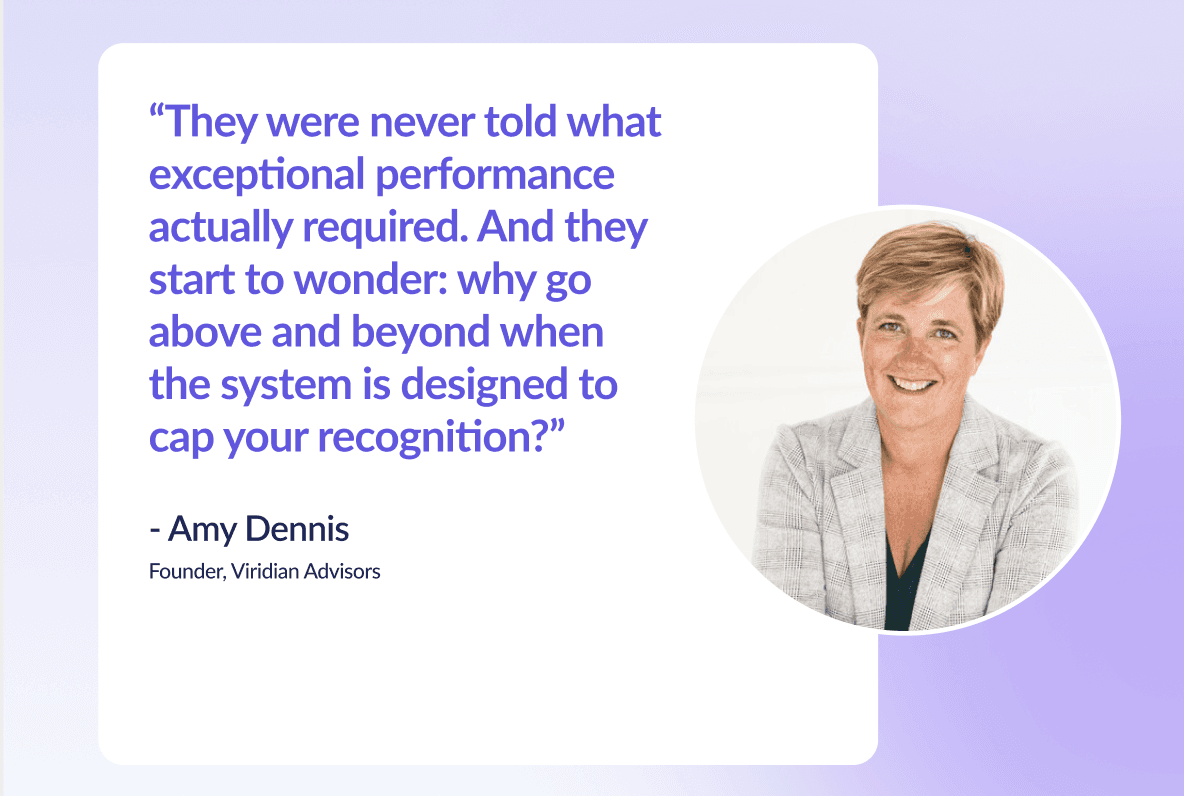
Dennis has seen this play out repeatedly across organizations she has worked with. “A high performer walks out of their review feeling confused and demoralized,” she says.
“They were never told what exceptional performance actually required. And they start to wonder: why go above and beyond when the system is designed to cap your recognition?”
The downstream effects are predictable: disengagement, reduced effort, and attrition. The data backs this up. Gallup estimates low engagement costs the global economy approximately $8.9 trillion annually. A McKinsey study found employees who do not feel their performance is evaluated fairly are nearly three times more likely to consider leaving within the year. Companies that have moved away from forced-ranking systems, - including Microsoft, Accenture, and Adobe - reported measurable improvements in collaboration and retention. The bell curve, Dennis argues, is not surfacing your best talent. It could be suppressing them.
Two Things That Need to Be Separated
Before reimagining performance management, Dennis says organizations need to untangle two things the bell curve bundles together: promotion and compensation.
On promotion, her view is direct: “Someone can be a truly excellent performer and not yet be ready for the next level. That is normal professional development, not a failure.” She is equally clear that a scarcity of leadership positions is a structural reality, not a reflection of anyone’s performance. When promotion becomes the primary reward in a review system, employees are set up for frustration and organizations for unnecessary turnover. “The more powerful question,” she says, “is whether this person is performing at a high level in their role and whether they have a clear picture of why that matters.”
On compensation, Dennis is equally pointed. Performance can be one input into pay decisions, but when it becomes the primary driver, forced ranking becomes a tool for managing payroll, not recognizing contribution. “When organizations use the bell curve to control the number of people eligible for significant raises,” she says, “they are managing their budget at the expense of their talent.”
A Better Model: Team-First Performance
So what does Dennis envision instead? When asked what the true purpose of a performance review should be, she reframes the question entirely:
“What if we refocus the purpose of performance reviews to make it a tool that aligns an individual’s daily work to the company’s overall strategy and financial objectives? Instead of driving performance for one individual, we need to give them a roadmap of what we need them to do and how we need them to do it so that it drives the overall performance of the company.”
In this model, employees are evaluated on clear, consistent expectations tied to actual business outcomes. Managers can say with confidence: here is what we needed from you this year, here is how you delivered it, and here is how your work moved the team forward. The benefits are concrete: reduced redundancy, stronger collaboration, and a clearer line between individual effort and organizational results.
Dennis often reaches for a sports analogy to make this concrete. “Imagine a soccer team,” she says. “Every player has a position—some flashier than others—but everyone is rewarded for winning. On successful teams, players naturally prioritize the collective because their own success is genuinely tied to the team’s.” The same holds in organizations: when individual performance is evaluated in the context of team goals, employees stop hoarding credit and start sharing it.
“Imagine if everyone was truly collaborating as a team,” Dennis says. “No fear of someone else getting credit for work you’ve done or an idea that you have.” That, she argues, is what becomes possible when you remove the zero-sum logic the bell curve introduces.
The Opportunity
For Dennis, the vision is straightforward: “Instead of having a small select group of exceptional employees, how do we give everyone a real chance to be exceptional?” Breaking the bell curve, she is careful to note, is not about lowering the bar. It is about setting a clearer one, and actually helping people reach it.
The organizations competing most effectively in the market are not the ones with the most rigorous ranking systems. They are the ones with the most aligned, energized, and clear-eyed teams.
About Amy Dennis
Amy Dennis is Principal at Viridian Advisors LLC, where she works with executives and leadership teams on performance strategy, organizational design, and the intersection of people operations and business results. Connect with Amy on Linkedin.