The Role of AI in Unifying Employee Feedback and Goal Tracking

Performance reviews are moving from annual dread to real-time growth. This guide details how to leverage AI to bridge the feedback gap and build a high-performance culture.

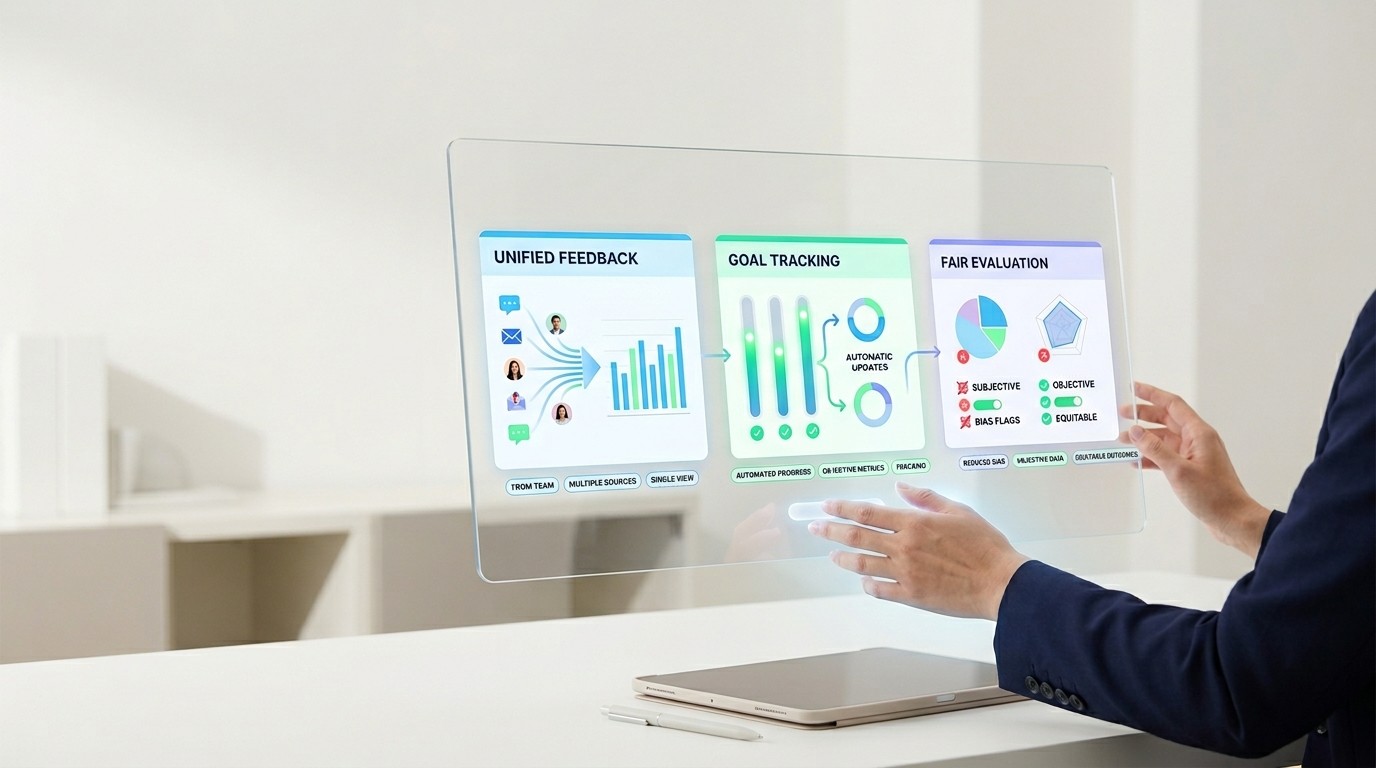
on

The annual performance review is a zombie process that manages to be both soul-crushing and statistically useless. Managers lose over 17 hours per cycle to paperwork that often relies on what happened last week rather than the last year.

17+ hours per manager is spent on administrative synthesis during traditional review cycles.

The era of the "once-a-year" surprise is over. By 2026, the organizations that thrive will be the ones that use AI to make feedback as continuous as the work itself.

The 2026 Performance Playbook

AI is transforming performance management from a compliance hurdle into a continuous growth engine. It allows leaders to focus on human connection while the machine handles the data synthesis.

  1. 30% reduction in manager time spent on documentation and synthesis.

  2. 25-26% increase in employee engagement through real-time feedback loops.

  3. Shift from annual cycles to Dynamic Performance Management (DPM).

  4. Bias reduction of up to 33% by using longitudinal data instead of human memory.

Why AI Is Rebuilding the Performance Engine

The "mental load" of management has reached a breaking point in the modern workplace. Sifting through a year of Slack messages, Jira tickets, and emails to write a review is impossible for a human.

According to Gartner, 20% of organizations will use AI by 2026 to flatten structures and automate middle management tasks. AI acts as a thinking partner that surfaces patterns you might otherwise miss.

Dynamic Performance Management allows you to pivot goals in real-time as market conditions change. Instead of waiting for December to course-correct, you can adjust targets the moment the data shifts.

This transition is essential for scaling growth in volatile markets where annual plans are obsolete within weeks. It ensures that every employee understands their impact on the bottom line every single day.

Step 1: Consolidate Your Source Truth

AI cannot create insights out of thin air; it needs a high-quality foundation of raw organizational data. Before you touch an LLM, you must centralize the disparate records of an employee's contributions.

  • Centralize all 1:1 meeting logs from the entire review period.

  • Export OKR and goal tracking data to show progress against targets.

  • Pull project-specific metrics and peer feedback from 360-degree surveys.

  • Document specific stretch moments where the employee exceeded expectations.

  • Gather external client praise or project completion timestamps.

Clean data is the only insurance against AI hallucinations during the drafting phase. If your input is vague, the output will be a collection of generic corporate buzzwords.

Rule: Never feed an AI tool sensitive personal data or PII (Personally Identifiable Information) unless using an enterprise-grade, secure environment.

Step 2: Choose Your AI Intelligence Stack

Building a modern intelligence stack requires moving beyond basic text generation. You need specialized capabilities that address specific friction points in the talent lifecycle.


Step 2: Choose Your AI Intelligence Stack

Real-Time Performance Tracking

This capability monitors output across integrated platforms like GitHub or Salesforce to provide instant visibility. It replaces the "black box" of traditional reviews with a transparent, living record of achievement.

  • How to Build It: Integrate your HRIS with project management tools using an API bridge like Worklytics to pull activity data into a central dashboard.

Sentiment Analysis

AI scans communication patterns to gauge morale and identify potential conflicts before they escalate. It helps managers understand the "vibe" of the team without needing to be in every meeting.

  • How to Build It: Deploy a sentiment engine that monitors anonymous feedback channels or public Slack threads to flag significant shifts in tone.

Predictive Retention Analytics

This feature identifies "flight risks" by spotting subtle changes in engagement and output levels. It gives you a 60-day head start to address dissatisfaction before a resignation letter arrives.

  • How to Build It: Feed historical turnover data into a predictive model that compares current employee behavior patterns against those who previously left.

Bias Detection Algorithms

These tools scan review drafts for gendered terms, inconsistent tone, or signs of recency bias. They ensure every employee is judged on the same objective merits regardless of who is writing the review.

  • How to Build It: Run all manager-written drafts through a specialized NLP model designed to flag subjective language or "halo effect" tendencies.

The right stack creates a "no surprise zone" where every employee knows exactly where they stand.

Step 3: Shift Focus to Outcome-Based Evaluation

The shift to AI doesn't just change how we review; it changes what we value in an employee. As AI takes over routine tasks, the premium on strategic thinking and problem-solving has never been higher.


Step 3: Shift Focus to Outcome-Based Evaluation
  • If an employee uses AI to finish tasks faster, then reward the strategic application of the saved time.

  • If the quality of output is high, then the specific tools used are secondary to the value added.

  • If a rubric focuses on activity metrics like emails sent, then pivot immediately to outcome metrics like revenue generated.

  • If you notice a digital divide, then provide training to ensure all employees have equal access to AI tools.

PwC research suggests that AI-driven analytics can reduce promotion bias by 33% by focusing on hard results. Establish a rubric that specifically rewards how employees navigate ambiguity and drive cross-functional results.

Managers must stop measuring effort and start measuring the actual delta an employee creates for the business. This is the only way to remain competitive as AI becomes a standard tool for every worker.

Step 4: Execute the Human-AI Loop

The most effective reviews are a collaboration between human intuition and machine processing. Start by providing the AI with the specific milestones and core objectives gathered in Step 1.


Step 4: Execute the Human-AI Loop
  1. Input raw data into your chosen AI agent to generate an initial structured draft.

  2. Review the draft for factual accuracy and hallucinations that might misrepresent work.

  3. Edit the tone to match your natural managerial voice and the specific culture of your team.

  4. Add qualitative context that only a human could know, like how an employee helped a teammate through a crisis.

  5. Disclose to the employee that AI was used to synthesize the data, ensuring total transparency.

Transparency builds trust while hiding AI usage creates a sense of being managed by a machine. The goal is to use the AI as a drafting partner that handles the 80% of administrative heavy lifting.

Imagine a manager who used AI to synthesize 500 peer comments for a senior lead. Instead of spending 5 hours reading, they spent 20 minutes refining a narrative that was more accurate than a human could have written alone.

Pitfall: Treating an AI draft as a final document without a human sanity check will lead to generic, disconnected feedback.

Critical Hazards to Avoid

Implementing AI in performance management is a cultural shift as much as a technical one. The fastest way to lose employee buy-in is through a lack of clarity or a breach of privacy.

  • Never input PII into public LLMs like the free version of ChatGPT; use enterprise-grade instances only.

  • Avoid over-reliance on the tool; AI is your thinking partner, not your replacement as a leader.

  • Watch for the digital divide where employees with higher AI literacy appear more productive than their peers.

  • Focus on outcomes rather than the mechanics of how the work was completed.

Privacy and ethics must be at the center of your implementation strategy to prevent a culture of surveillance. If employees feel monitored rather than supported, engagement will plummet regardless of the technology.

Static vs. Dynamic Performance Management

The transition from legacy systems to dynamic models represents a fundamental change in HR philosophy. According to the Betterworks Performance Enablement Report, this shift significantly improves the employee experience.

Feature

Traditional Review

AI-Powered Dynamic Review

Frequency

Annual or Periodic

Continuous and Real-time

Objectivity

Subjective / Recency Bias

Data-driven / Longitudinal

Prep Time

17+ hours per manager

~6 hours with AI agents

Outcome

Static Documentation

Actionable Coaching & Growth

Focus

Historical Activity

Future-focused Outcomes

Bias

High Human Subjectivity

Algorithmic Bias Detection

Modern managers use these tools to move from being judges to being coaches.

Frequently Asked Questions

Can AI really reduce bias in my reviews?

Yes, by analyzing data from the entire year rather than just the last few weeks, AI helps eliminate recency bias. Tools like Betterworks also scan for gendered or subjective language that humans often overlook.

How do I handle the black box problem where AI makes a decision I can't explain?

You should never allow the AI to make the final decision; it should only synthesize the data for you to review. Always ensure you can trace an AI's recommendation back to the original project metrics or feedback logs.

Will employees feel like they are being watched by Big Brother?

Transparency is the only antidote to this fear. Clearly explain what data is being tracked and how it is used to help them grow, rather than just to punish low performance.

Do I need to train my managers before rolling this out?

Absolutely, as AI literacy is a prerequisite for success. Managers need to know how to prompt the AI effectively and, more importantly, how to edit the output for human context.

The Future of Feedback Is Already Here

The future of performance management isn't about the tool you choose. It is about the fundamental shift from tracking activity to measuring outcomes and growth.

AI handles the synthesis, giving you the space to be the coach your team deserves. Start by centralizing your data today.

Explore More Articles