The Manager's Guide: How to Align Employee Goals with Reviews Using Software

Modern performance management isn't about annual snapshots; it's about continuous alignment. Discover the workflow, methodologies, and software tools that turn employee goals into measurable business impact.

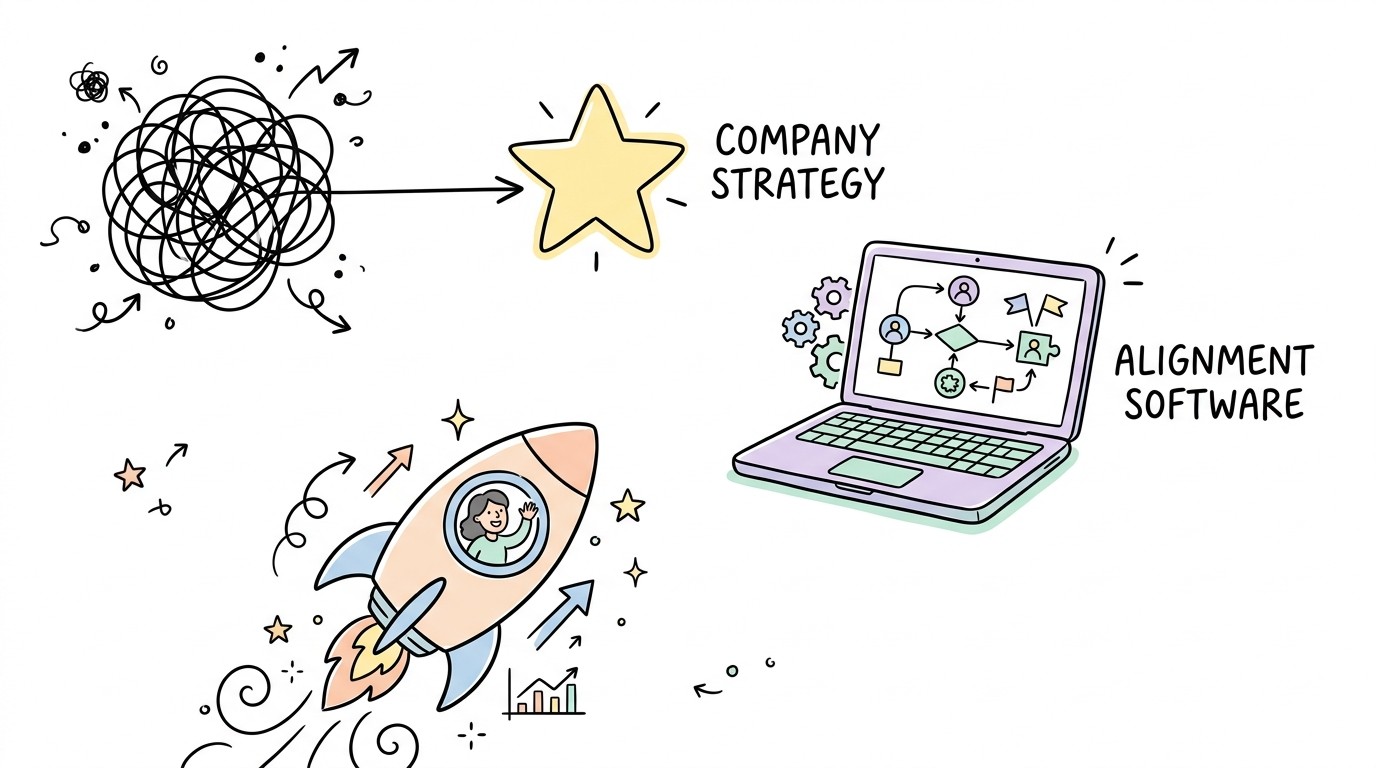
on

The core problem you face as a manager isn't poor performance; it is poor memory. You and your team are likely operating in a fog where the daily grind obscures the big picture objectives you set months ago.

Only 26% of employees clearly understand how their individual work connects to company goals. In an AI-driven, hybrid world, the traditional annual review is a relic that fails to capture the velocity of modern work.

If you are still relying on spreadsheets and a mad scramble for data every December, you aren't just losing time. You are losing the engagement of your highest-performing people who want to see their impact in real time.

Reviews should be a summary of a year well-documented, not a stressful reconstruction of forgotten projects. The gap between strategy and execution is where productivity dies, and alignment software is the only way to bridge it.

The Bottom Line on Alignment

Companies that successfully align individual goals with organizational needs see a 22% increase in employee performance. This isn't just about tracking tasks; it is about creating a direct line of sight from the CEO to the newest hire.

Engagement scores jump by 50% when people understand exactly why their work matters. Goal alignment software moves the manager's role from a judge who grades performance to a coach who guides it.

  • Align goals to boost performance by 22%.

  • Increase engagement by 50% through clear strategic visibility.

  • Use software to automate admin work and focus on 1:1 coaching.

  • Shift from annual snapshots to continuous feedback loops.

What Is Software-Driven Goal Alignment?

Goal alignment is the process of ensuring every employee's objective directly supports the organization's broader strategic priorities. Without a system, goals often become silos that have nothing to do with the company's bottom line.

Software-driven alignment uses a concept called cascading goals to create a hierarchy of objectives. This ensures that when leadership articulates the "Why" for the year, it flows down to every individual contributor automatically.

30% Lower turnover rates for companies with robust goal alignment.

Modern platforms adopt a "windshield" approach to management. Rather than looking in the rearview mirror at the end of the year, you see the road ahead through real-time data according to the Betterworks 2026 State of Performance Enablement.

Technology eliminates the admin drudgery of chasing down status updates. Instead of asking "what have you done?" in a review, you can focus on "how can I help you?" based on the data already in the system.

Choosing Your Framework: OKRs vs. SMART Goals

Before you buy software, you must decide which language your team will speak. Most platforms support multiple frameworks, but your choice dictates how your culture feels and operates.

SMART Goals

SMART goals are the workhorses of the operational world. They focus on making objectives Specific, Measurable, Achievable, Relevant, and Time-bound.

These are perfect for steady-state roles or short-term projects where the path to success is already well-defined. They provide a clear "pass/fail" grade that makes performance reviews straightforward but can sometimes limit creative risk-taking.

OKRs (Objectives and Key Results)

OKRs are designed for growth and strategic shifts. The Objective is an inspirational "what," while the Key Results are the quantifiable "how."


OKRs (Objectives and Key Results)

This framework encourages teams to set aspirational targets that might only have a 70% success rate. Because they are often transparent across the whole company, they break down silos and force cross-departmental collaboration.

WOOP (Wish, Outcome, Obstacle, Plan)

WOOP is a behavioral framework that helps employees visualize success and plan for the friction they will inevitably face. It is less about tracking and more about building the mental resilience needed to hit high-stakes targets.

Decision Rules

  • If your team focuses on repetitive, high-volume tasks, then use SMART goals for clarity.

  • If you are in a high-growth phase or changing strategy, then use OKRs to drive innovation.

  • If your primary issue is employee burnout or lack of follow-through, then integrate WOOP into your check-ins.

  • If you choose OKRs, then ensure you use them to guide progress rather than strictly grading performance to avoid sandbagging.

The 6-Step Workflow to Align Goals with Reviews

Connecting daily work to a formal review is a cycle, not a one-time event. When you use software like Lattice, you turn performance management into a continuous conversation.

Step 1: Define Corporate Strategy

Leadership must articulate the top-level objectives for the year within the software dashboard. If the company goal is to "Boost product innovation by 20%," that needs to be the North Star that everyone else anchors to.

Step 2: Cascade and Ladder

Managers take those company goals and help their teams build objectives that ladder up. For example, an engineer might set a goal of shipping three new features by the fourth quarter to support that innovation target.

Step 3: Configure Your Templates

Use the built-in templates in your software to ensure every goal is measurable. If a goal isn't quantifiable, it shouldn't be in the system, as vague goals lead to subjective and biased reviews later on.


Step 3: Configure Your Templates

Step 4: Enable Continuous Feedback

Schedule your 1:1s directly within the platform. According to Google re:Work, documenting these frequent touchpoints is what prevents the "year-end surprise" that ruins employee trust.

Step 5: Integrate Daily Workflows

Link your goal software to the tools your team actually uses, like Slack, Jira, or Salesforce. This allows for automated progress updates so employees don't have to manually enter data twice.

Step 6: Generate Data-Backed Reviews

When review season arrives, use the platform's history to generate an evaluation. You will have a full year of check-ins, goal progress, and peer feedback ready to go, making the final review an objective summary of reality.

Consider Sarah, a marketing lead at a fast-growing startup. She missed her campaign goals because her team was focused on secondary metrics that didn't align with the CEO's vision. Since she didn't have software tracking these in real-time, she only realized the misalignment during the end-of-year review, resulting in lost bonus opportunities and team frustration.

Tip: Avoid tying OKRs directly to compensation or bonuses. If you do, employees will set safe, uninspired goals (sandbagging) rather than the ambitious targets that drive company growth.

Implementation Checklist

  • Upload your company mission and yearly pillars to the software homepage.

  • Ensure every employee has at least one goal linked to a team objective.

  • Set an automated reminder for employees to update their goal progress every Friday.

  • Conduct at least one documented 1:1 check-in per month within the platform.

  • Audit your goals mid-year to retire objectives that are no longer relevant.

Top Tools for Goal-Review Integration

Choosing the right tool depends entirely on your company size and existing workflow. Every one of these platforms offers a way to bridge the gap between goals and evaluations.

Lattice

Lattice is the gold standard for growth-stage companies that need a unified platform for goals, reviews, and engagement surveys.

Description: A comprehensive suite that excels at cascading alignment and making company strategy visible to every employee.

Features: Integrated 360-degree reviews, goal-tracking dashboards, and real-time feedback tools.

Verdict: Best for mid-market companies that want a single source of truth for all people operations.

You can explore their features at Lattice.

Betterworks

Betterworks is built for large-scale organizations that need deep reporting and sophisticated calibration tools.

Description: An enterprise-grade platform that focuses on high-performance OKR alignment for thousands of employees.

Features: Strategic alignment maps, AI-assisted review drafting, and advanced manager calibration sessions.

Verdict: The top choice for global enterprises with 100,000+ employees who need scalability.

Learn more at Betterworks.

15Five

15Five focuses heavily on the relationship between managers and employees through continuous coaching.

Description: A platform designed to turn managers into coaches by centering the workflow around the weekly check-in.

Features: Best-in-class 1:1 meeting agendas, high-five recognition, and role-based review templates.

Verdict: Best for organizations that want to prioritize manager development and employee psychological safety.

Check out their coaching tools at 15Five.

Leapsome

Leapsome connects performance tracking with professional development and skill building.

Description: A platform that treats performance and learning as two sides of the same coin.

Features: Skills-based performance tracking, automated learning paths, and competency frameworks.

Verdict: Ideal for teams that want to keep individual goals and professional development in one place.

Visit Leapsome for more details.

Teamflect

Teamflect is the primary choice for teams that live entirely inside the Microsoft ecosystem.

Description: A performance management tool built natively for Microsoft Teams and Outlook.

Features: Direct integration with Teams meetings, Outlook task syncing, and easy-to-use OKR tracking.

Verdict: The winner for Microsoft-heavy organizations that want high adoption without adding another login.

Find it at Teamflect.

Example

A support team lead uses Teamflect to track the goal "Increase completed support tickets by 15% monthly." Because the tool integrates with their existing workflow, the progress updates automatically as they close tickets in their helpdesk, giving the manager a real-time health check without manual reporting.

Which Alignment Software Fits Your Team?

Software

Best For

Top Feature

Price Range

Lattice

Growth Companies

Cascading Goal Maps

Mid-Tier

Betterworks

Large Enterprises

Calibration & Reporting

Premium

15Five

Manager Coaching

1:1 Check-in Agendas

Mid-Tier

Leapsome

Skill Development

Integrated Learning Paths

Mid-Tier

Teamflect

Microsoft Users

Teams/Outlook Native

SMB Friendly

Weekdone

Small Teams

Weekly OKR Tracking

SMB Friendly

Common Alignment Pitfalls (and How to Avoid Them)

Even the best software can't fix a broken culture. If you treat these tools like a digital version of your old paper forms, you will likely repeat the same mistakes.

One common error is "Set-and-Forget" syndrome. This happens when teams enter their goals in January and never look at the software again until November.


Common Alignment Pitfalls (and How to Avoid Them)

Another major hurdle is recency bias. Managers often forget what happened in Q1 and rate employees based on the last few weeks of work, which destroys the fairness of the review.

Pitfall: Beware of sandbagging. If employees know that hitting 100% of an OKR is the only way to get a raise, they will set incredibly easy goals that don't help the company grow.

  • Sandbagging: Setting conservative goals to ensure a payout.

  • Recency Bias: Evaluating based on the last month instead of the full year.

  • Manual Tracking: Relying on spreadsheets that lack real-time visibility.

  • Confusing OKRs with KPIs: OKRs are for change; KPIs are for business-as-usual.

Frequently Asked Questions

What is the difference between goal-setting and performance management software?

Goal-setting software focuses on tracking objectives and progress over time. Performance management software includes those goals but also adds reviews, peer feedback, and often learning or compensation modules.

Should OKRs be tied to compensation?

Generally, no. OKRs are meant to be aspirational, and tying them to pay encourages employees to set uninspired, safe targets to ensure their bonus.

How do we measure the ROI on these software tools?

You can measure ROI through reduced administrative time for HR, higher employee engagement scores, and a measurable increase in goal completion rates across the company.

Is this software useful for small teams?

Yes, tools like Weekdone or Teamflect are designed specifically for smaller teams to provide the same strategic clarity that giant corporations use without the high price tag.

From Admin to Architect

Software doesn't just manage data; it makes trust visible and actionable. By moving from a once-a-year scramble to a continuous alignment model, you give your team the clarity they need to succeed.

2026 demands real-time impact visibility and data-backed fairness. You cannot lead effectively if you are managing in the dark about how daily tasks connect to the company's survival.

The first step is simple. Pick one department, choose a tool, and start your pilot today.

Explore More Articles