Modern Performance Management: The Complete Guide to Continuous Growth (2026)
Traditional annual reviews are failing 82% of hybrid teams. This playbook outlines how to build a continuous performance system focused on real-time growth, psychological safety, and data-backed calibration.

The annual review is a corporate ghost that haunts your calendar once a year. It is a relic of a different era, and doesn't serve the fluid, hybrid work environments of 2026. Most managers loathe the paperwork, and employees dread the judgment. According to Gallup, under 20% of employees find traditional reviews inspiring or helpful for their growth.
This disconnection creates a dangerous gap in distributed teams. Research shows that 82% of HR leaders believe old systems fail to capture performance accurately in a remote or hybrid setting. The ritual of looking back at twelve months of work in a thirty-minute meeting is fundamentally broken. Modern performance management practices solve these issues by replacting the appraisal with constant and coninuous coaching.
This shift is not just about implementing new technology; it is about moving from a culture of evaluation to a culture of development. We must align individual ambitions with company strategy in real-time. This guide will show you how to build a system that people actually value.
The TL;DR on Modern Performance
Modern performance management is a continuous, data-driven loop focused on growth rather than past judgment. By shifting to high-frequency feedback, organizations see a significant ROI in employee output.
A 39% improvement in performance is attributed to frequent, high-quality feedback loops.
Continuous check-ins and OKRs replace the rigid, annual top-down appraisal process with a more productive system.
360-degree feedback and calibration meetings provide a holistic view of impact in hybrid teams.
Modern systems decouple coaching conversations from salary negotiations to maintain trust.
What Is Modern Performance Management?
Modern performance management is a strategic process that uses open dialogue to align individual growth with organizational goals. It moves away from the 'annual' mindset toward an 'agile' framework. The focus is no longer on documenting past failures to justify a 3% raise. Instead, it prioritizes real-time feedback and data-driven insights to drive future results. This transition is essential for companies navigating the complexities of 2026.
According to research from Gallup Performance Management Research, the core of this shift is the move from manager-as-judge to manager-as-coach. While traditional systems look backward, modern systems prioritize 'feedforward.' This involves discussing what is needed for future success rather than obsessing over unchangeable past mistakes.
The goal is to create a rhythm where employees always know where they stand. This clarity reduces anxiety and increases engagement. By integrating goal-setting frameworks like OKRs, you ensure that every team member understands how their daily tasks contribute to the big picture. It is a living system that evolves with your business.
How to Build Your Performance Playbook
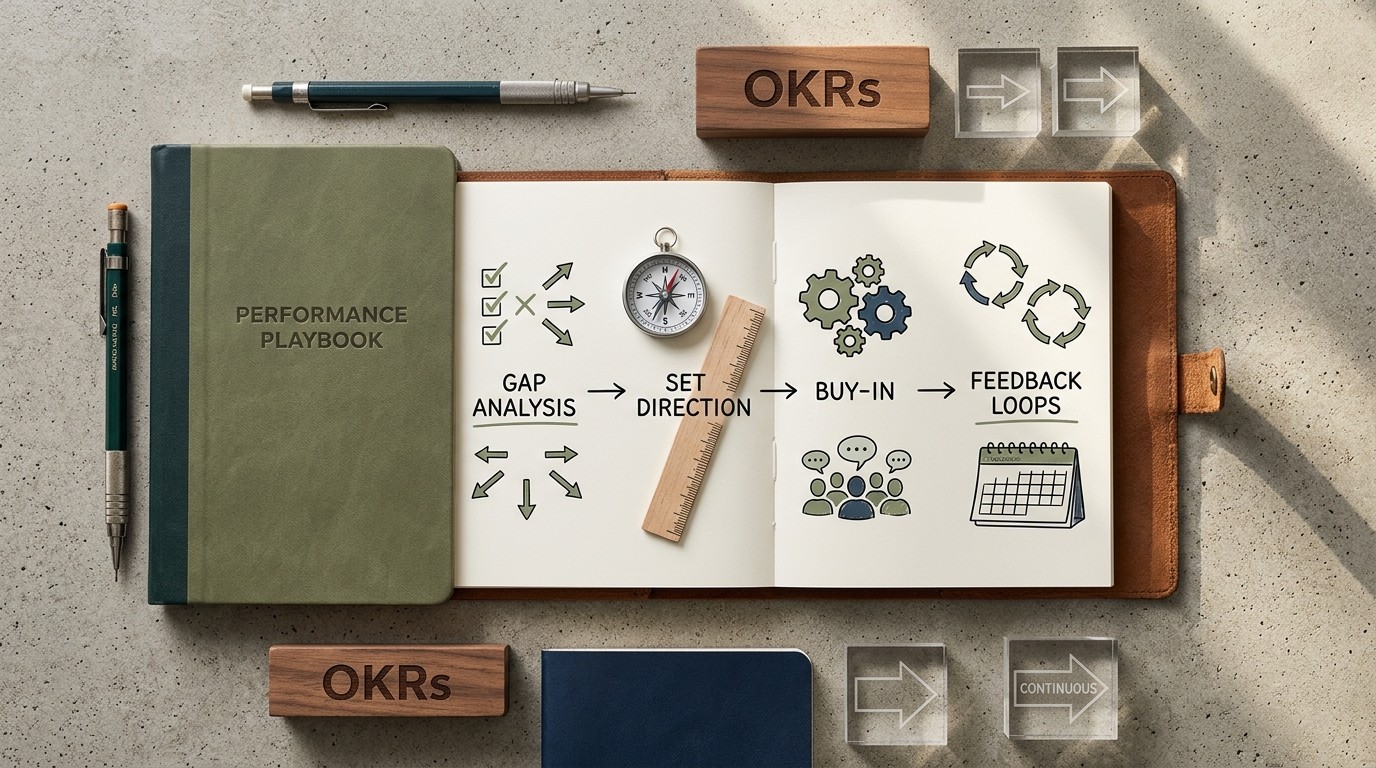
Implementing a new performance system is a change management project. You are changing the way people communicate and how they perceive their value. To succeed, you need to follow a logical sequence that builds trust and demonstrates ROI at every stage. Below is a step-by-step process to create the right performance playbook to implement a modern performance management system.
Step 1: Assess and Survey
You cannot fix what you have not measured. Start by surveying both managers and employees to identify the specific friction points in your current system. Ask if they feel their current reviews are fair, timely, and helpful. This data becomes your baseline for measuring the success of the new playbook.
Step 2: Secure Stakeholder Buy-in
Executives need to see the business case for change. Present the data showing that frequent feedback can lead to a 39% performance boost. Frame performance management as a profit driver rather than an HR cost center. Use the survey results from Step 1 to show the hidden costs of the status quo, such as turnover or low engagement.
Step 3: Design the Framework
Decide on your feedback cadence and goal-setting methodology. Will you use weekly pulse questions or monthly deep dives. Will you adopt the OKR Framework or stick to SMART goals. Define these rules clearly in a digital playbook so there is no ambiguity about expectations for managers or employees.
Step 4: Integrate the Tech Stack
Deploy a platform that fits into the existing workflow. If your team lives in Slack or Microsoft Teams, your performance tool should too. Technology should reduce the friction of feedback rather than adding another login to manage.
Step 5: Train for Coaching
Most managers were promoted because they were good at their jobs, not because they are good at coaching. You must educate them on how to ask growth-oriented questions. Provide them with scripts and frameworks for difficult conversations. This training ensures that the new system results in better conversations, not just more of them.
The 5 Pillars of a Growth-First Culture
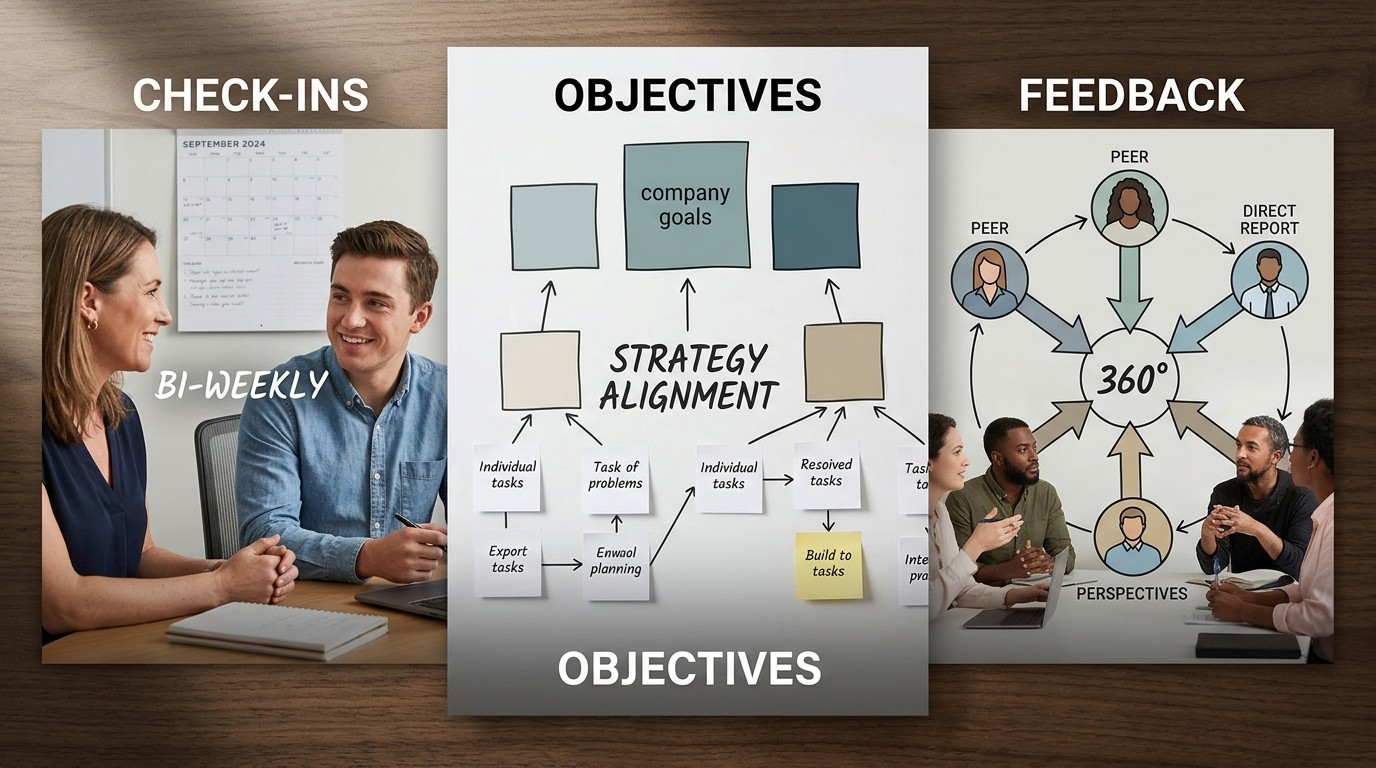
To build a high-performance culture, you must move beyond the basics of HR compliance. The following pillars form the foundation of a modern system that supports both the employee and the business. These mechanisms ensure that performance is a constant conversation.
Continuous Feedback & Check-ins
This mechanism replaces the annual review with bi-weekly or monthly touchpoints. These are short, intentional conversations focused on current obstacles and immediate wins. Frequent touchpoints prevent small issues from becoming exits and keep priorities aligned.
Why it works: It provides the real-time course correction necessary for fast-paced, hybrid work.
Implementation: Set up a recurring 15-minute sync every two weeks. Make sure employees answer two questions: what is going well and where are they stuck. Keep the conversation focused on career growth and performance solutions.
Focus on Objectives and Key Results (OKRs)
OKRs align individual contributions with high-level company strategy. They focus on measurable outcomes rather than just activities. When everyone knows the 'why,' productivity increases because effort is directed toward impact.
Why it works: It creates a transparent map of how individual work can move the needle for the entire company.
Implementation: Draft three ambitious objectives for the quarter. For each, define 2-3 measurable key results. Share these in a public dashboard where your employees can access them. Review progress monthly to adjust targets based on market shifts.
Collect 360-Degree Feedback
This approach gathers perspectives from peers, direct reports, and even clients to provide a holistic view of performance. This multi-directional feedback balances the manager's perspective and reduces the risk of individual bias.
Why it works: It gives the employee and manager a holsitic view of their performance.
Implementation: Make sure to frequently ask peers three specific questions: what should this person start, stop, and continue doing. Ensure all feedback is constructive and tied to specific observed behaviors rather than personality traits.
Have Frequent Performance Calibration Meetings
Calibration is a meeting where managers review their ratings together to ensure consistency. It prevents one 'easy' manager from inflating scores while a 'tough' manager suppresses them. Calibration is the primary tool for fairness in a modern, distributed workforce.
Why it works: It protects the organization from bias and ensures that promotions are truly merit-based.
Implementation: Group managers by department for a two-hour session after a review cycle. Display names and proposed ratings on a screen. Discuss outliers (very high or very low performers) to ensure the evidence justifies the rating compared to peers in similar roles.
Individual Development Plans (IDPs)
IDPs are personalized roadmaps that focus on skill acquisition and career paths. They shift the focus from what the employee does for the company to what the company does for the employee. Personalized growth plans help communicate that the company is invested in the individual's growth.
Why it works: It signals that the organization is interested in supporting the employee and their growth.
Implementation: Dedicate one check-in per quarter solely to career growth. Identify two skills the employee wants to master. Track the application of these new skills in their daily work over the following six months.
Tip: Start small by implementing bi-weekly check-ins before rolling out complex OKR frameworks to avoid overwhelming your team.
Traditional vs. Modern: What’s Actually Changing?
The data-driven nature of modern systems removes the guesswork from talent management.
Feature | Traditional Performance | Modern Performance |
|---|---|---|
Frequency******* | Annual or semi-annual | Continuous or real-time |
Focus******* | Past performance and judgment | Future growth and coaching |
Direction******* | Top-down and hierarchical | Multi-directional and 360-degree |
Data Source******* | Subjective and manual | Data-driven |
Goal Style******* | Static annual KPIs | Agile and transparent OKRs |
Outcome******* | Pay justification | Talent development and ROI |
Trust is Key
Trust is the currency of performance management. If employees feel the system is rigged or that coaching is just a trap to document failures, they will disengage. You must be intentional about separating development from discipline. Failing to decouple coaching from salary talks is the fastest way to kill honest dialogue.
Performance managment implementation is not software implementation; it is a cultural shift. If leadership does not participate in the feedback loop, the rest of the organization will quickly see it as a hollow HR exercise.
Turning Performance into Competitive Advantage
The annual review is not dead, but the 2020 version of it certainly is. In 2026, performance management is about building a culture of transparency and growth. It is the engine that drives your competitive advantage by ensuring your talent is aligned with your strategy. This is one of the most powerful competitve advantages that a company can possess.
Modern Performance FAQ
How can AI be used in modern performance management?
AI is primarily used to identify hidden bias patterns and track performance data and conversations. It can save managers hours of manual work, allowing them to focus of coaching development. However, AI should never make the final decision on promotions or terminations.
What if my team is too busy for bi-weekly check-ins?
If a manager does not have fifteen minutes every two weeks to discuss progress with a direct report, the team is likely over-capacity or misaligned. Frequent check-ins actually save time in the long run by preventing major project failures and reducing the time spent on formal, annual documentation.