Managing Distributed Teams: How Unified Software Drives Performance in 2026
In 2026, managing remote performance requires more than just Zoom calls. This playbook explores how unified software and AI-driven metrics are replacing static reviews to drive 16% productivity gains.

Managing a team you cannot see is the ultimate leadership stress test. In 2026, the traditional office has officially dissolved into the ether.
Visibility is no longer about seeing bodies in chairs but about seeing results in a dashboard. Leaders who still hunt for green status dots are losing their best talent to companies that trust outcomes.
If you are still managing by presence, you are playing a losing game. The shift to distributed software is not just a tech upgrade; it is a fundamental survival strategy.
The 2026 Remote Performance Cheat Sheet
The landscape of distributed work has shifted toward high-efficiency, data-driven ecosystems.
Productivity boost: Teams using outcome-based frameworks see 13-16% higher output than those tracking hours.
AI intervention: 73% of companies now use AI to identify burnout risk through focus time tracking.
Retention spike: Continuous development loops increase remote-first retention by 35% compared to annual cycles.
Unified focus: High-performing teams protect deep work, achieving 41% focus time daily.
Why Static Reviews Failed The 2026 Workforce
The annual review is officially a relic of a slower era. By 2026, over 36 million Americans work primarily from home, making the once-a-year feedback cycle dangerously slow.
Static reviews fail to capture the reality of daily output in a distributed environment. This delay creates a visibility gap where high performers feel ignored and struggling employees drift into burnout.
36.2 million Americans working from home by 2026.
Modern performance management relies on a real-time ecosystem. We have moved from proximity bias to a culture of shared context where progress is tracked in living documents and decision logs. This ensures everyone is measured by the value they create rather than their ability to stay online.
Step 1: Unify Your Performance Tech Stack
Start by auditing your current tech stack for redundancy. Most distributed teams suffer from app sprawl, where goals are in one tool and feedback is buried in another.
Aim for one unified platform that connects your OKRs, performance reviews, and workforce analytics. This centralization eliminates fragmented data and ensures a single source of truth for every employee.
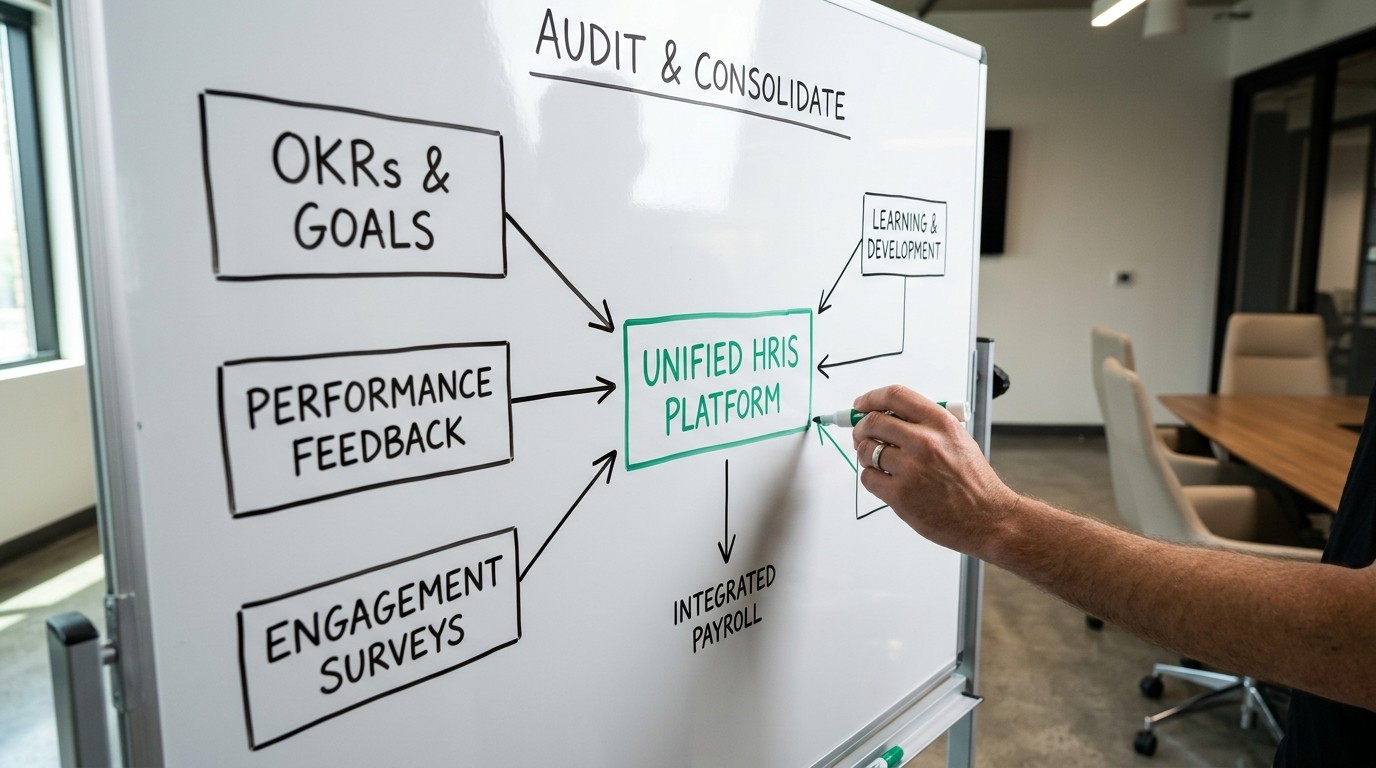
Identify tools with overlapping functions and cut the excess.
Prioritize platforms that offer native integrations with Slack or Microsoft Teams.
Replace informal 'shoulder-tap' Slack check-ins with transparent project spaces.
Ensure all performance data flows automatically into your payroll and compensation modules.
Step 2: Transition To Outcome-Based Metrics
The fastest way to destroy trust in a remote team is through keystroke tracking. In 2026, the gold standard is the quality of AI-augmented output and milestone completion.
Stop measuring hours logged and start measuring project velocity. This shift empowers employees to own their schedules and focus on deep work windows.
Rule: If a task can be measured by time alone, it is likely a candidate for automation rather than a human KPI.
Elite remote teams are now reaching a 41% focus time benchmark. This is achieved by protecting deep work windows and treating focused output as the primary metric of success. When you focus on what gets finished, the 'where' and 'when' become irrelevant.
Step 3: Deploy AI For Burnout And Focus Tracking
AI is no longer a futuristic concept but a supportive partner for the modern manager. By 2026, smart platforms track cognitive fatigue by flagging significant dips in focus time.
AI reduces review prep time by 40% by synthesizing feedback loops into actionable summaries. This allows managers to spend their time on coaching rather than administrative data entry.
Consider the scenario of a senior lead at a global firm whose focus hours dropped sharply over two weeks. Instead of a performance warning, the system flagged a burnout risk, allowing the manager to provide a mental health break before the employee quit.
Use Lattice to automate the collection of 1:1 notes and goal progress.
Let AI draft performance summaries, but keep human empathy at the center of the final delivery.
Monitor workload balance through automated dashboards to prevent high-performer fatigue.
Step 4: Formalize Asynchronous Feedback Loops
Asynchronous work is the only way to scale distributed performance without causing meeting fatigue. High-performing teams prioritize decision logs and searchable handbooks over constant video calls.
Establish a documentation-first culture where every major decision is written down. This allows team members across different time zones to stay aligned without waiting for a synchronous meeting.
Tip: If a meeting does not have a written agenda and a documented outcome, it should have been an asynchronous update.
Integrate continuous feedback loops directly into your communication tools like Slack.
Create a centralized team handbook that defines collaboration norms and communication expectations.
Use video messages for nuance and documents for technical specifications.
Reward employees for contributing to shared context rather than just sending high message volumes.
Legacy Management Vs. The 2026 Standard
The gap between legacy management and the 2026 standard is widening. Companies that cling to old habits face higher turnover and stagnant growth compared to their unified peers.
A unified approach connects daily work to long-term growth automatically. This removes the friction of manual tracking and keeps every team member focused on the highest-impact tasks.
Feature | Legacy Management | 2026 Unified Standard |
|---|---|---|
Core Metric******* | Hours logged and availability | Project milestones and focus time |
Feedback******* | Annual or bi-annual reviews | Continuous AI-augmented loops |
Data Flow******* | Disconnected task and payroll tools | Single platform for goals and compensation |
Culture******* | Synchronous and meeting-heavy | Asynchronous and documentation-first |
Visibility******* | Proximity bias (who is in office) | Outcome-based (who is delivering) |
Top Unified Software For Remote Performance
Lattice
Description: A comprehensive people success platform designed for high-growth firms that value the connection between individual performance and company goals.
Features:
Real-time 1:1 tracking and automated feedback prompts.
Integrated OKR management that links daily tasks to broad business objectives.
AI-driven sentiment analysis to gauge team engagement trends.
Verdict: Best for tech-forward companies that want to prioritize continuous coaching and employee development over static appraisals.
Betterworks
Description: An enterprise-grade performance enablement solution that focuses heavily on AI-powered alignment and goal cascading.
Features:
AI assistants that help managers write more objective and constructive reviews.
Robust OKR tracking for large-scale organizations with complex hierarchies.
Career development modules that map out internal growth paths.
Verdict: The top choice for large enterprises needing to align thousands of employees across multiple global regions.
Workday Performance
Description: A component of the massive Workday ecosystem that provides deep integration between performance data and global payroll.
Features:
Seamless connection between performance ratings and annual compensation adjustments.
Advanced succession planning based on real-time skill inventory data.
Global compliance tools for managing distributed workforces across borders.
Verdict: Ideal for global corporations already using the Workday suite who need high-level security and compliance.
15Five
Description: A coaching-centric platform built on the philosophy that frequent feedback is the foundation of high performance.
Features:
High-frequency 'Check-ins' that take only fifteen minutes for employees to complete.
Science-backed manager training modules integrated into the workflow.
Focus on employee strengths and holistic well-being tracking.
Verdict: Best for organizations that prioritize manager training and want to build a culture of psychological safety.
BambooHR
Description: A user-friendly HRIS designed specifically for small and medium-sized businesses that need to automate their core HR functions.
Features:
Automated appraisal cycles that send reminders to managers and employees.
Simple, visual goal tracking that is easy for non-technical teams to use.
Integrated employee satisfaction (eNPS) surveys to monitor team morale.
Verdict: The best all-in-one solution for SMBs looking to transition from spreadsheets to a unified performance system.
Verification Checklist: Is Your Strategy Working?
A successful distributed strategy requires constant verification of your internal systems. If your data is siloed or your managers are overwhelmed, the system is failing.
Every individual OKR must roll up to a larger company strategy for the team to remain focused. Regular audits ensure that your technology is serving your people rather than creating more work.
Every major team decision is logged in a central, searchable document.
Employees can view their progress against company-wide OKRs in real-time.
Managers spend less than one hour preparing for performance reviews due to AI synthesis.
Focus time metrics are used to protect employees from burnout rather than for punishment.
Your unified platform automatically syncs performance data with compensation cycles.
Remote Performance Management: Your Questions Answered
How do we stop micromanagement in distributed teams?
Micromanagement usually stems from a lack of trust or clear metrics. By shifting to outcome-based KPIs and project milestones, managers can see progress without needing to watch every keystroke. Unified software provides the visibility needed to step back and focus on results.
Is AI-driven focus tracking ethical?
It is ethical when used as a supportive tool for well-being rather than a surveillance tool for punishment. In 2026, 73% of companies use this data specifically to identify burnout and redistribute workloads. Transparency with the team about how the data is used is critical for maintaining trust.
How do we handle performance across different time zones?
Asynchronous communication is the answer to the time zone challenge. By using decision logs and centralized handbooks, you ensure that every employee has the context they need to work independently. This removes the 'waiting for an answer' bottleneck that kills productivity in global teams.
Can unified software reduce app sprawl?
Yes, by consolidating feedback, goals, and reviews into one platform, you eliminate the need for multiple subscriptions and context switching. This single source of truth ensures that data is consistent and that employees know exactly where to go for performance information.
Leading The 2026 Distributed Frontier
Trust is no longer a soft skill; it is a competitive advantage in the 2026 economy. Distributed teams that master unified software and outcome-based metrics outpace their competitors by focusing on what truly matters.
The era of monitoring is over and the era of enablement has begun. By leveraging AI to protect focus time and unifying your data, you build a resilient, high-performing culture.
Move away from the 'shoulder-tap' mentality and embrace the documentation-first frontier. Your team's performance depends on the shared context you build today. Evolution is the only way forward.