How to Sync OKRs and Performance Reviews Without Performance Bias
This guide reveals the playbook for decoupling goals from pay while maintaining objective, data-driven evaluations.

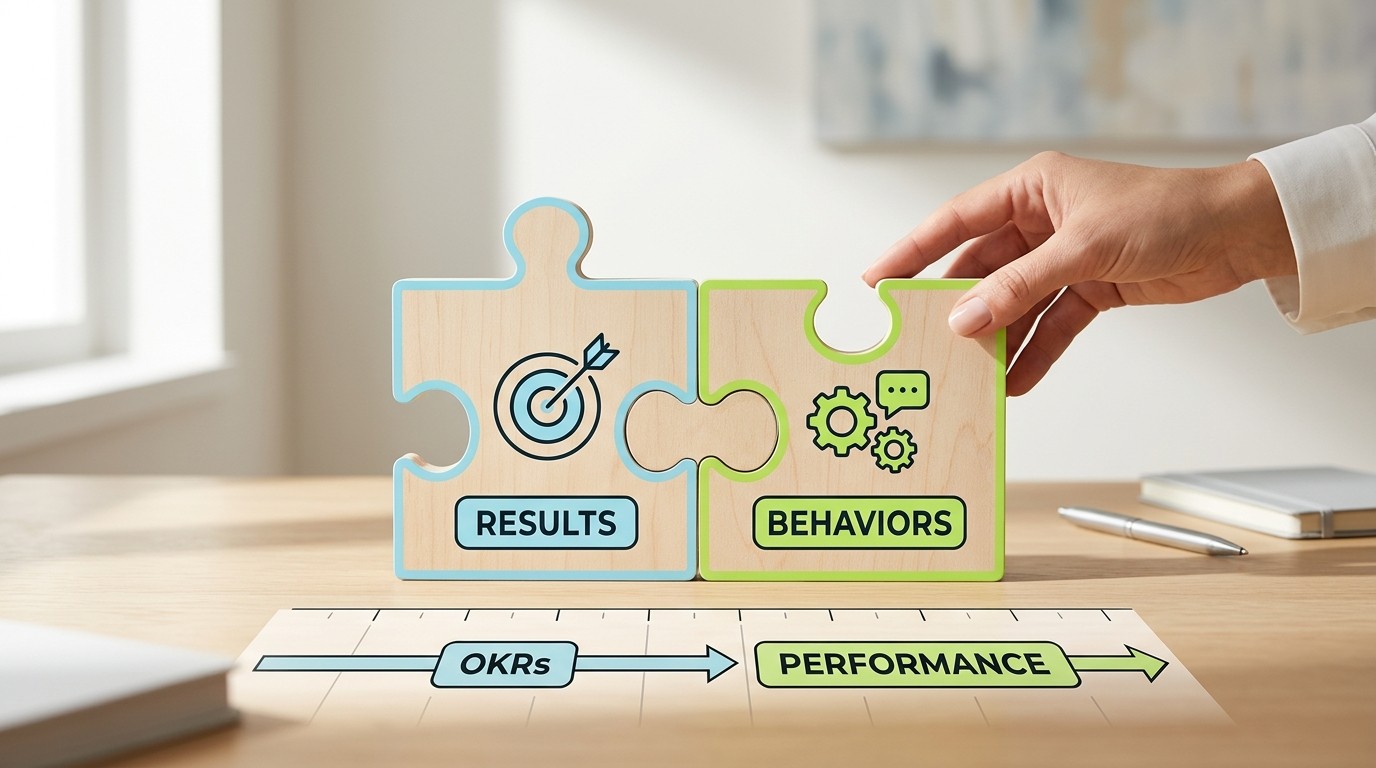
Bias thrives in ambiguity. When goals are fuzzy, feedback feels like it is based on gut feelings rather than actual work. Linking these frameworks directly often backfires by causing employees to sandbag their targets to protect their paychecks. This disconnect creates a culture of fear where innovation is de-incentivized.
High-Impact Integration
You can modernize your evaluation process by following a few high-impact rules. Separate the scoring of business outcomes from the evaluation of individual growth to keep people focused on growing in their roles.
Understanding The Difference: OKRs Vs. Performance Management
OKRs are a strategy-alignment framework designed to drive business outcomes. They focus on the team's collective impact and high-level objectives. Performance management is a developmental framework centered on individual competencies and behaviors. While OKRs track the output, performance management tracks how the individual grows within their role. OKR are a compass for the business rather than a scorecard for the soul.
Decouple OKR Scoring From Salary Reviews
Decoupling money from growth conversations is the only way to protect your innovation culture. If employees fear missing stretch targets because it affects pay, they will stop trying to pursue them.
Finalize OKR scores at the very end of the quarter.
Wait exactly four weeks before conducting any salary or performance reviews.
Use this buffer to let the business data settle before shifting to human development.
Avoid using a mathematical formula that turns OKR percentages into automatic bonus calculations.
Rule: Separate the OKR review and the salary review by at least one month to decouple money from growth.
Evaluate The 'Process' Rather Than Just The Percentage
Not all misses are created equal. You must differentiate between a lack of effort and external blockers like market shifts or internal reorgs.
Evaluate the initiative and collaboration shown while pursuing a difficult goal.
Review the data trail to see if the employee pivoted effectively when faced with obstacles.
If the goal was innovation, decouple OKRs from pay completely to encourage risk.
If the role is predictable like high-volume sales, use KPIs for pay and OKRs for improvement.
Tip: In reviews, evaluate the initiative used to pursue the goal, not just the final number.
Build A Continuous Feedback Loop (CFRs)
Annual reviews are too slow for the modern pace of business. Move toward a quarterly or bi-weekly cadence to keep feedback relevant and actionable.
The CFR model provides the human side of the framework by focusing on conversations, feedback, and recognition. Schedule bi-weekly check-ins to discuss progress and blockers.
Standardize your questions to ensure every employee is judged on job-relevant criteria.
Use these sessions to provide immediate recognition for small wins.
Neutralize Bias Through Data Anchoring
OKRs serve as a data anchor that prevents managers from relying on gut feelings. This objective trail is the antidote to ratings bias over long cycles.
Recency bias occurs when a manager over-weights an employee's most recent successes or failures. Without an OKR trail, the manager might only remember a recent failure and unfairly penalize the entire quarter.
Use OKR history to counteract a situation where one trait overshadows actual output.
Reference quarterly data to avoid central tendency bias where everyone is rated as average.
Maintain a digital record of impact to ensure reviews are based on evidence.
Compare OKR progress against initial quarterly commitments.
Moving Toward Data-Driven Fairness
Transparency is the ultimate mechanism for workplace fairness. By using OKRs as an objective data anchor, you move from subjective opinions to evidence-based growth. Remember that these frameworks are tools for alignment, not weapons for enforcement. Keep your conversations human and your data clean to build a culture of high performance.