How AI-Powered Feedback Tools are Eliminating the Need for Annual Reviews
The traditional annual review is obsolete. Discover how AI performance management software uses real-time data to create a high-performance culture without the administrative burnout.

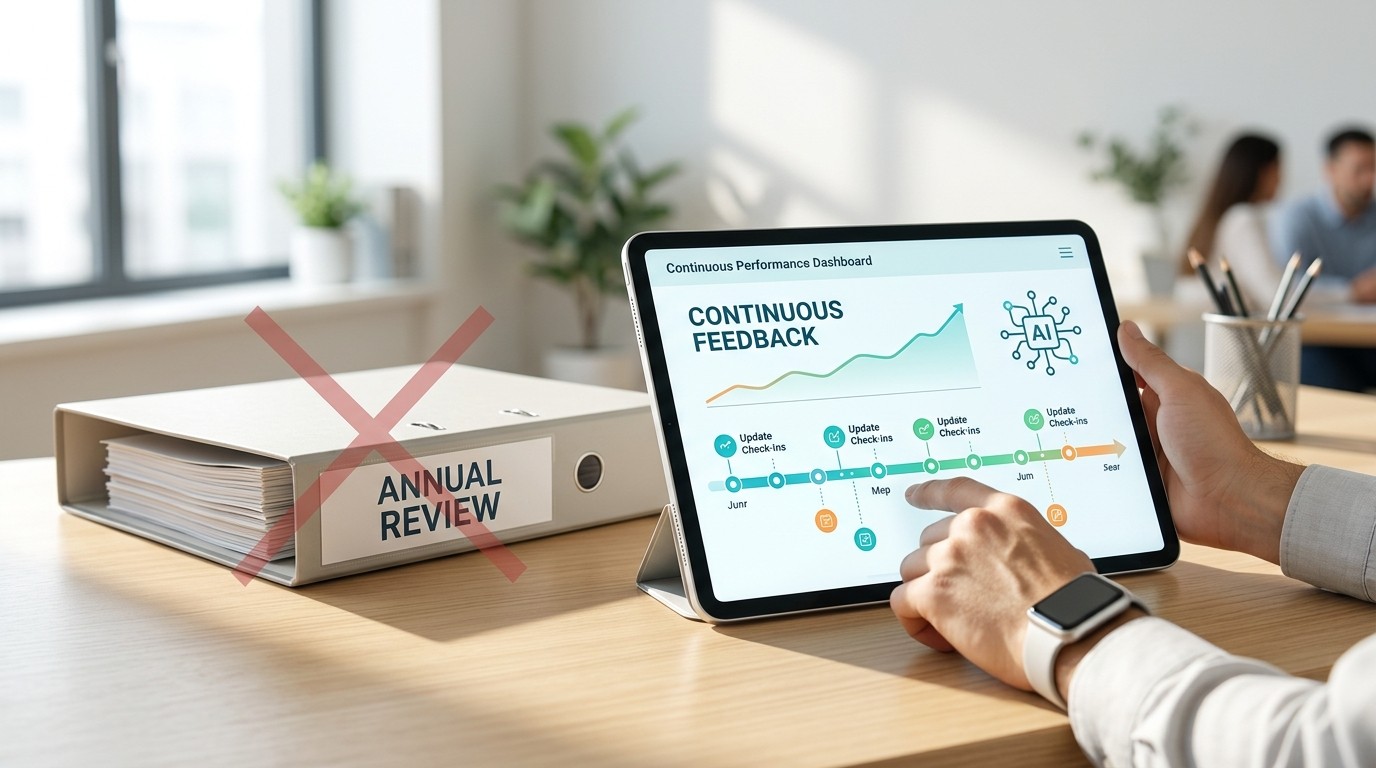
The annual performance review is solving for the wrong problem. The traditional performance reviews is an inefficient, ineffective tool for evaluation. It isn’t about understanding the employee experience, or coaching them toward business and career growth. They are also too slow for modern agile work cycles where goals change monthly. By the time the meeting happens, the feedback is irrelevant and the data is clouded by recency bias. AI assistance has the potential to transform this bureaucratic ritual into a real-time development engine that actually helps people grow.
Bottom Line:The 2026 Shift To Continuous Enablement
The landscape of talent management has shifted toward evidence-based enablement rather than backward-looking scores. Leadership teams are now using AI to close the gap between strategy and execution.
AI can automate the majority of administrative performance prep work for managers.
Continuous feedback loops lead to an 89% employee satisfaction rate.
Predictive analytics and NLP reduce human manager bias significantly.
Real-time work signals replace static documents to create a preserved file of growth.
Performance management is now a continuous coaching conversation rather than a yearly event.
Why The Annual Performance Snapshot No Longer Works
The traditional annual snapshot is no longer compatible with the speed of business. When feedback only happens once every twelve months, it creates a high-stress environment that focuses on past mistakes rather than future potential.
Managers are currently buried under the weight of manual documentation and administrative sprawl. Static appraisals also fail to capture the nuance of collaborative, cross-functional projects. The delay between action and feedback prevents course correction in real-time.
AI has fundamentally redefined what high performance means. The focus has moved away from arbitrary scoring and toward identifying the specific behaviors that drive results. This shift requires a system that tracks signals as they happen.
The AI-Assisted Performance Management Software
AI performance management software is a layer of intelligence that sits on top of your existing communication and project tools. It uses Natural Language Processing (NLP) to analyze sentiment and impact across different work channels.
Instead of a manager guessing how a project went, the AI captures work signals and synthesizes them into continuous evidence-based insights that can be accessed at any time.
The technology typically includes three core components:
Goal Assist: Predictive tools that help employees set realistic, measurable OKRs based on past velocity.
Feedback Assist: Generative agents that help managers turn bullet points into professional, actionable feedback.
Calibration Engines: Data models that flag potential bias or inconsistencies across different departments or demographics.
Think of it as a preserved employee file of growth. It is a dynamic record of every win and learning moment that occurred throughout the year. This ensures that every 1:1 conversation is grounded in reality rather than memory.
Old Guard vs. AI-Native: Comparing Review Cycles
Moving from an annual model to an AI-native system requires a shift in mindset. You are moving from a world of snapshots to a world of continuous development loops.
Feature | Traditional Annual Review | AI-Powered Performance |
Review Frequency******* | Once per year | Continuous real-time feedback |
Manager Prep Time******* | ||
Data Sources******* | Single manager memory | Multi-source work signals |
Employee Satisfaction******* | ||
Primary Objective******* | Scoring the past | Enabling the future |
Bias******* | High recency bias | Significant bias indicators throughout system |
This transition allows managers to focus on high-value coaching instead of data entry. It ensures that no contribution goes unnoticed just because it happened ten months before the review date.
How To Transition To An AI-Powered Performance Culture
Transitioning to AI-powered feedback is a cultural shift that requires clear communication and manager buy-in to be successful. The friction of starting from scratch is gone, and managers actually have time for real conversations. A phased approach ensures you can verify the data quality before rolling it out company-wide. Dr. Ben Dattner’s Pre-Diagnostic Tool helps you build a library of internal use cases that prove the tool's value to skeptical leaders.
Avoiding AI Bias
The biggest risk with AI is treating it as a replacement for human judgment. If managers stop paying attention and simply click 'approve' on every AI summary, you create a new kind of bias. AI is a tool for preparation and synthesis, but the human connection is the part that actually drives performance and engagement. Zal.ai’s system is serious about being HR and manager-led and AI-assisted.
Unlocking The Future Of Talent Intelligence
Performance is how strategy gets executed. When you see performance data in real-time, you unlock the ability to pivot faster and keep your team aligned with your highest goals.
The performance review must shift from scoring the past to enabling the future. By removing the administrative burden of reviews, you give your leaders the space to be mentors rather than judges. This is how you build a culture of performance, one that thrives on growth and high-performance intelligence.
Frequently Asked Questions About AI Performance Management
Can AI replace the need for annual appraisals?
AI does not eliminate the need for performance assessment, but it removes the administrative burden. It replaces the yearly high-stakes meeting with continuous, evidence-based conversations that happen in real-time.
Is AI performance management biased?
Studies from IBM and HBR show that AI-powered analytics can reduce manager bias by 50%. By using multi-source data instead of just manager memory, the system provides a more equitable view of employee contributions.
How do employees feel about AI tracking their work?
When implemented with transparency, employee satisfaction rates reach 89%. Most workers prefer data-driven reviews over subjective manager opinions because they feel more 'heard' and fairly evaluated.