A Guide to HR Tech Stack Consolidation: Unifying Goals and Feedback
HR tech bloat is costing your team 2.5 hours of productivity every week. This guide provides a strategic playbook for auditing, mapping, and consolidating your tools into a unified ecosystem.


You are likely managing between 80 and 100 disconnected tools if you work in a large organization. This fragmentation creates a friction-heavy environment where the simple act of checking a goal or approving a leave request requires five different logins. This isn't just an IT headache: it is a productivity killer that degrades the employee experience every single day.
The cost of this friction is known as the toggle tax, the cognitive load required to jump between interfaces. Every time a manager switches from a performance review tool to a learning management system, they lose focus and momentum. We have reached a breaking point where the search for the perfect niche tool has compromised the integrity of the entire system.
The Bottom Line on Consolidation
The value of consolidation is measurable in both dollars and hours. By removing redundant systems, you can secure significant budget relief and give your team back their most valuable resource: time.
Financial Recovery: Average organizations waste 30-40% of their HR tech budget on redundant software features.
Direct Savings: Successful consolidation projects typically save between $100k and $250k per year in licensing and maintenance.
Productivity Gains: Eliminating context switching generates an average weekly gain of 2.5 hours per professional.
Data Integrity: Moving to a unified ecosystem ensures a single source of truth, reducing manual data entry errors by half.
Why Your Stack Is Breaking (And Why Now?)
HR and IT are no longer separate entities. In fact, 64% of IT leaders predict a total merger of these departments within the next few years to handle increasing tech complexity.
Historically, HR software was built as a system of record to store static data like addresses and social security numbers. In 2026, we are moving toward ecosystem orchestration, where tools interact dynamically to guide the employee journey. If your data lives in separate silos, you cannot utilize the next generation of Agentic AI.
64% of IT leaders predict a total HR-IT merger.
Agents like GaliLeo or Sloneek require a unified data pool to provide predictive intelligence on things like turnover risk or skill gaps. According to Deloitte 2026 Human Capital Trends, organizations that fail to unify their data will be left behind by competitors using AI to optimize their workforce. Siloed data makes it impossible for an AI assistant to see that a drop in performance feedback is directly linked to a lack of training in a specific module.
Phase 1: The Hard Audit and Shadow IT Discovery
The first phase of consolidation is unmasking the truth of your current stack. You cannot fix what you cannot see, and most HR leaders are unaware of the shadow IT lurking in department budgets.
Start by reviewing corporate credit card statements and expense reports to find rogue subscriptions. An HR manager might discover twelve separate corporate cards are paying for the same LinkedIn Learning license because departments are not talking. This redundant spend drains $12,000 annually from the training budget before a single course is even taken.
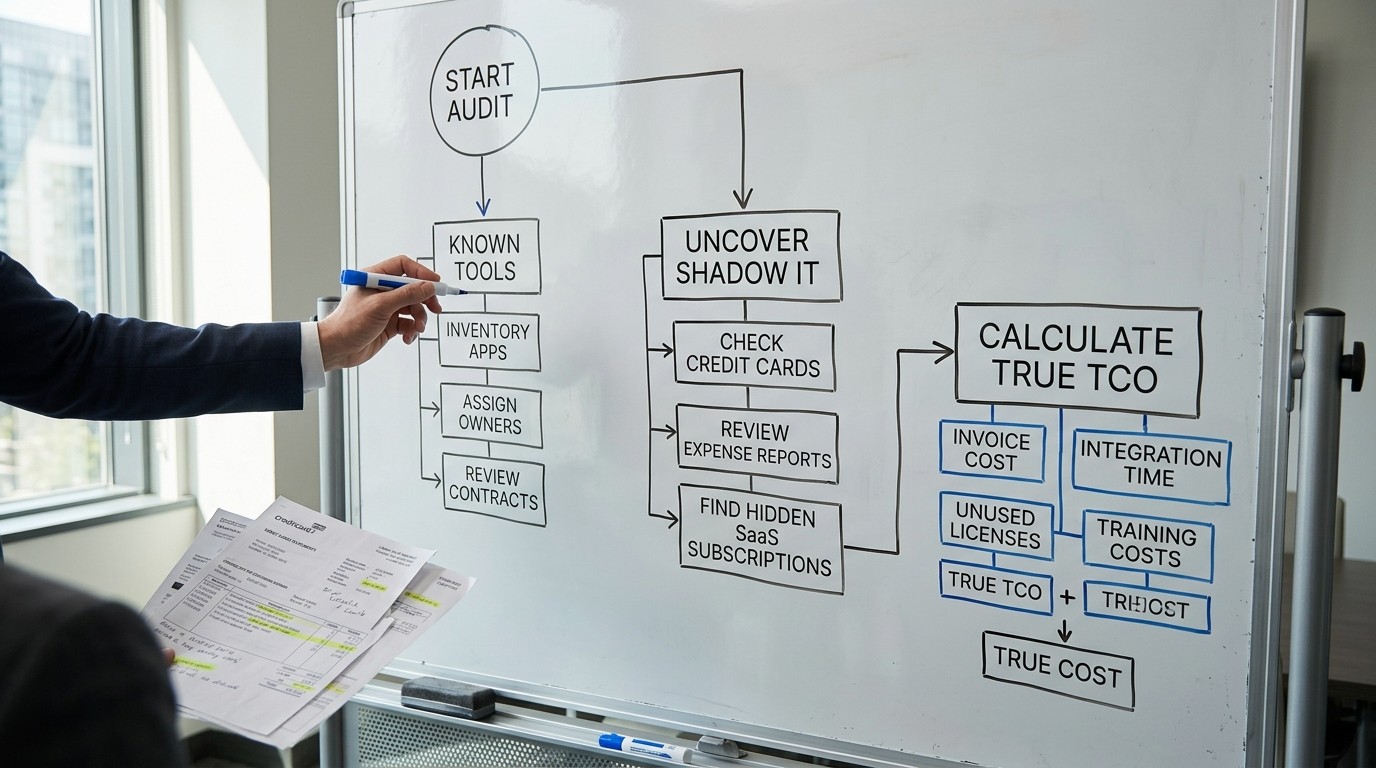
Use the OutSail HR Tech Audit Template to organize your findings. You must calculate the True Total Cost of Ownership (TCO), which includes hidden IT maintenance and the time spent on manual data synchronization between apps.
Audit all existing software licenses and their expiration dates.
Identify the official owner and the actual user count for each tool.
Catalog every integration, noting if they are native or require custom middleware.
Calculate the annual cost per employee for every tool in the stack.
Survey managers to identify which tools they find redundant or confusing.
Rule: If a tool has a usage rate below 20% or lacks a native integration to your core HRIS, it is a primary candidate for removal.
Phase 2: Redundancy Mapping and the 'Two-Question' Filter
Once you have a list of tools, you need to map them against a five-layer framework to see where you are over-indexed. The modern stack consists of Foundation, Infrastructure, Talent, Optimization, and Intelligence.
Most teams find they have three different tools for the Optimization layer, such as separate apps for surveys, performance, and feedback. Fragmented optimization layers create a disjointed experience that frustrates employees. Use a two-question filter for every tool: Does this talk to the core HRIS, and does it serve a unique business goal that no other tool can handle?

If a tool serves a unique, high-value purpose, keep it.
If a tool overlaps 80% with another, consolidate to the one with the higher adoption rate.
If a tool does not support API-based data sharing, replace it.
If a legacy suite is actually just different codebases stitched together, treat it as a point solution.
Unifying Goals and Feedback: The Performance Core
The heart of consolidation is the link between how people grow and how they are measured. When your learning management system (LMS) is disconnected from your performance reviews, training becomes a check-the-box exercise rather than a strategic lever.
By unifying these systems, you create a virtuous cycle where performance gaps automatically trigger relevant training modules. A mid-sized tech firm might use three different tools for reviews, goal setting, and training. Managers in that scenario spend more time chasing passwords than coaching, leading to a 15% dip in engagement scores during a critical push because the feedback feels disconnected from their growth.
Example
A manager marks an employee as 'Needs Improvement' in Python coding during a review. In a unified stack, the system automatically suggests a specific Python certification course from the integrated LMS. Once completed, the 'Skill' is updated in the employee's profile, and the goal status moves to 'Achieved' without manual input.
This unification allows you to use sentiment analysis to predict turnover risk. If feedback frequency drops and training engagement stalls, the system can alert HR before the employee decides to leave. Using tools like Lattice helps centralize these feedback loops so that every conversation is backed by real-time data.
Phase 3: Execution and the 'Clean Data' Migration
Technical migration is the easy part; the real challenge is convincing your team to change how they work. You must treat this as a transformation project where only 30% of the effort is technical and 70% is change management.
Clean and validate your data in legacy systems before you even think about the transfer. If you move messy data into a new unified platform like Rippling, you will simply have a faster way to generate incorrect reports. Roll out the new system in phases, starting with the core records and payroll before moving to more complex areas like talent acquisition.
Pitfall: Never migrate historical data without a prior audit, as 'dirty data' from old systems will break your new automation workflows.
Communicate the 'why' behind the change to the entire company. Focus on the benefits for the end user, such as fewer passwords and a clearer path to promotions. This reduces the friction of adoption and ensures the investment pays off.
Measuring Success: The Post-Consolidation Scorecard
You cannot manage what you do not measure, so you must define what success looks like after the tools are merged. The most important metric is the reduction in administrative burden, which allows HR to focus on strategy rather than spreadsheets.
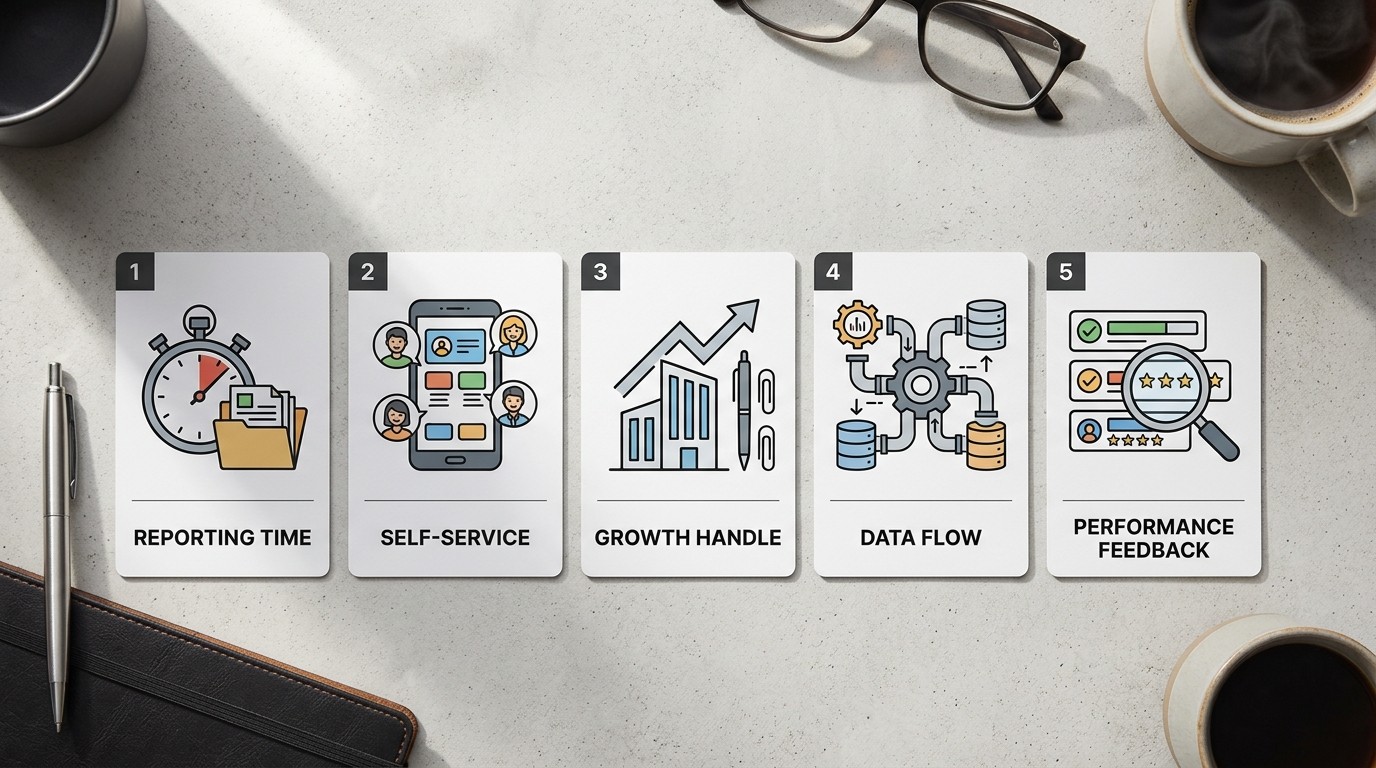
KPI | Target | Description |
|---|---|---|
Report Generation Time | 50% Reduction | Time saved by having a single data source for all HR metrics. |
Self-Service Adoption | 80% Usage | Percentage of employees who update their own info without HR help. |
Growth Scalability | 0% Admin Increase | The ability to handle 20% headcount growth without adding HR staff. |
Vendor Count | 40% Reduction | Cutting the number of separate invoices and security reviews managed by IT. |
If your new stack cannot handle a 20% increase in headcount without a corresponding 20% increase in HR administrative hours, your consolidation effort has failed. The goal is to build an engine that scales effortlessly.
Future-Proofing Your People Operations
Consolidating your HR tech stack is about more than just saving money on software licenses. It is about building a foundation where data flows seamlessly between every touchpoint of the employee lifecycle.
By unifying goals and feedback, you transform HR from a cost center into a strategic engine that drives business value. Stop paying the toggle tax and start investing in a system that empowers your people to do their best work. The technical debt you ignore today will be the barrier to your growth tomorrow. Evaluate your stack, cut the bloat, and unify your data.
Frequently Asked Questions
Is a 'Best-of-Breed' strategy still viable?
While niche tools offer specialized features, the integration cost usually outweighs the benefits for mid-market and enterprise firms. A unified platform provides 90% of the functionality with 100% of the data integrity. Only choose best-of-breed for highly specific needs like complex global compliance or specialized technical assessments.
What is the 'Consolidation Trap'?
The trap occurs when organizations buy a 'Legacy Suite' that claims to be unified but is actually several different products bought by a parent company. These often have different user interfaces and require manual data syncing. True consolidation requires a single, unified codebase where data moves instantly across modules.
How long does a full tech stack consolidation take?
A typical project for a mid-sized organization takes six to nine months from audit to full adoption. This timeline allows for thorough data cleaning, vendor evaluation, and phased rollouts. Rushing the process often leads to poor data quality and low employee adoption rates.
Should I involve the IT department in HR tool selection?
Yes, involving IT is critical for security reviews and integration planning. Since many HR tools now touch on device management and identity verification, a close partnership ensures the stack remains secure and compliant with corporate standards.